


There is no single “success rate” for California personal injury lawyers, because most cases never reach a courtroom. The vast majority settle out of court, and national court data shows plaintiffs win roughly half to two-thirds of the tort trials that do go before a judge or jury, depending heavily on the type of case. So a lawyer’s real track record depends less on trial wins than on the settlements they negotiate for clients.
Hillguard Injury Lawyers is led by founding partner David E. Jacobson, a member of the State Bar of California who has recovered more than $10 million for injured Californians. From the firm’s Sherman Oaks office, the team helps injured clients pursue compensation across practice areas — including car accidents, traumatic brain injuries, and wrongful death — in 49 California cities. If you want a candid assessment of your claim, contact us for a free consultation.
This article explains what “success rate” really means in personal injury law, how win rates differ by case type, what drives a strong result, and how to choose a California attorney who can protect your interests.
What “Success Rate” Really Means in a Personal Injury Case
Most people picture a courtroom when they imagine a personal injury lawsuit. The data tells a different story. The California Judicial Council’s 2026 Court Statistics Report (FY 2024–25) indicates that 83% of unlimited civil cases are resolved before reaching trial.
So “success rate” is a slippery phrase. A settlement is not a trial win, and the two should never be confused. A lawyer who settles a personal injury claim for fair value has done the job, even though no judge ever ruled. When you read a law firm advertising a 98% “win rate,” ask what they are counting. Settlements? Dismissals? Trials? The number means little without that context.
For most personal injury victims, the real question is not “will we win at trial?” but “will this claim recover what my losses are worth?” That is where preparation and evidence matter far more than any headline statistic.
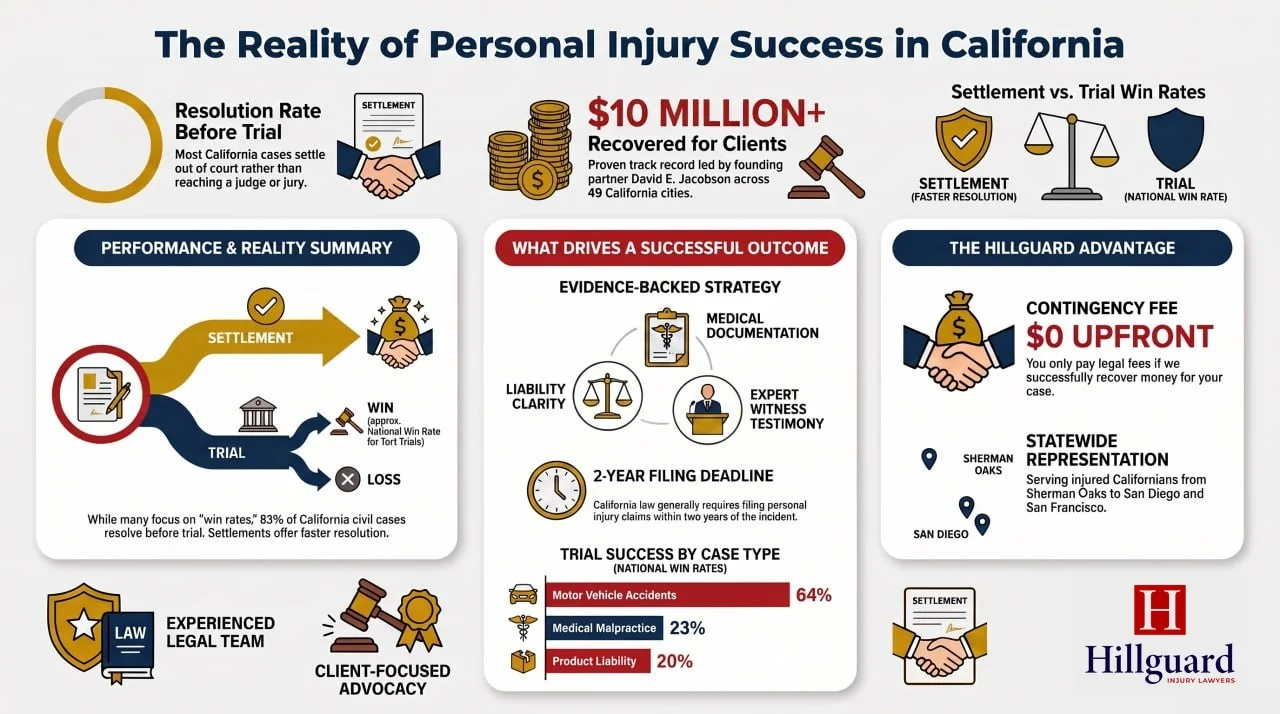
Personal Injury Trial Win Rates in California and the U.S.
California does not publish plaintiff win rates for personal injury cases. No state agency tracks them that way. The best national picture comes from the BJS, whose tort trial studies give a historical baseline. Treat these as national, historical figures. They are not a prediction for any individual case, in California or anywhere else.
Across all tort trials, plaintiffs won roughly 56% of the time, per BJS. The forum changes the odds: plaintiffs prevailed in about 68% of bench trials before a judge, but in only 54% of jury trials.
Why Win Rates Vary by Case Type
The headline number hides a wide variation. A car crash case and a medical malpractice claim are not the same fight. The table below shows national plaintiff trial win rates by case type, drawn from BJS data. Again, these are historical, national figures, not a forecast for your claim.
| Case Type | Plaintiff Trial Win Rate (BJS, national, historical) |
|---|---|
| All tort trials | approximately 56% |
| Auto/motor vehicle | approximately 64% |
| Medical malpractice | approximately 23% |
| Product liability | approximately 20% |
Auto cases win most often because fault is frequently clear. A driver ran a red light, rear-ended someone, or broke a traffic law. Medical malpractice and product liability sit far lower, because proving causation against doctors or manufacturers is difficult and expensive.
What Actually Drives a Lawyer’s Success Rate

A lawyer’s track record reflects the cases they take and how they build them, not magic. A few factors move outcomes more than anything else.
Liability clarity comes first. When the at-fault party plainly broke a rule, the claim is stronger. When the responsibility is unclear, the opposing party puts up a stronger fight. A slip caused by a dangerous condition, an injury from a defective product, or a car crash from a red light runner: each personal injury claim turns on different proof.
Evidence strength is next. Police reports, medical records, and eyewitness accounts turn a he-said story into a documented one. Cases with undisputed evidence of negligence tend to resolve better.
Injury severity matters too. Serious, well-documented injuries carry more serious damages than minor ones. So does insurance coverage, because a claim is only as collectible as the at-fault party’s policy limits. Finally, the forum. A judge and a jury can read the same facts differently, which is part of why bench and jury win rates diverge.
How Experienced Attorneys Build Strong Cases
An experienced personal injury attorney earns results through process, not promises. The work starts early.
Good lawyers investigate the accident scene before the evidence disappears. They photograph the location, preserve physical proof, and gather evidence from witnesses while memories are fresh. They collect the police report and early statements that lock in what happened.
Then comes the medical side. Obtaining medical records and linking them to the accident establishes the causation link, which is the proof that this crash or fall caused these injuries. When the medicine is complex, attorneys bring in expert witnesses to explain it to an insurer or jury.
Building the file early does something useful. It pressures the insurance company to settle for fair value. An adjuster who sees a trial-ready file and the evidence a lawyer can present behaves differently from one looking at a thin claim. Preparation, not mere confidence, leads to better results.
Settlement, Trial, and How Long Cases Take

Most personal injury cases settle. The BJS trial data confirms how rare verdicts are. A settlement is usually faster and more predictable than a courtroom gamble.
Timing varies widely. BJS court data put the median time to resolve a tort case at roughly 14 months. Cases that went to a jury trial took far longer, around 23 months from filing. These are general ranges, not a schedule for any single claim. Yours could move faster or slower depending on its facts.
One industry dynamic is worth knowing. Insurers track which law firms actually try cases. A firm with a credible willingness to go to court tends to be taken more seriously in negotiation. That reputation is built over years, and it can shape how early an insurer offers fair value rather than a lowball settlement.
California Rules That Affect Whether You Win
California law shapes every personal injury claim. A few rules matter most.
Deadlines come first. The statute of limitations for most personal injury cases is two years from the injury date, under California Code of Civil Procedure section 335.1. Claims against a government entity are far tighter. You generally must file an administrative claim within six months under Government Code section 911.2. Failing to meet either deadline may result in losing the claim.
California uses a pure comparative negligence system. If you are partly at fault, your recovery drops by that percentage, but you can still recover. To win, a plaintiff must prove four elements: duty, breach, causation, and damages.
Damages are split into two types. Economic damages cover provable losses such as medical bills and lost wages, shown through receipts, invoices, and wage statements. Non-economic damages cover pain and suffering and emotional distress.
Medical malpractice carries special caps. Under California’s MICRA (Medical Injury Compensation Reform Act) law, as amended by AB 35, non-economic damages in med-mal cases are capped at roughly $390,000 for non-death claims and $500,000 for wrongful death as of January 1, 2024, rising each year toward $750,000 and $1 million by 2033. These caps apply only to medical malpractice, not to other personal injury matters.
Most California personal injury lawyers work on a contingency fee basis, so your financial situation should not keep you from getting help. There is no upfront money. Under this fee structure, attorneys’ fees typically run about 33% to 40% of the recovery, higher only by written agreement. The firm usually advances case costs on a contingency basis and reimburses them from any recovery. You pay only if the case succeeds.
Common Mistakes to Avoid After an Injury
Some habits quietly weaken a strong claim. The most common is delaying medical treatment. Gaps in care give an insurance company room to argue your injuries were minor or unrelated. Consult a doctor and continue with your recovery.
Missing the statute of limitations ends a claim before it starts, so calendar the deadline early. Another frequent error is giving the insurance company a recorded statement before getting legal advice. Adjusters are trained to use your own words against the claim.
Accepting the first settlement offer is rarely wise, because early offers tend to undervalue the full extent of your losses. Posting about the accident on social media can hand the other side evidence. A casual post can be twisted to dispute how serious your injuries really are. The biggest mistake of all is trying to handle a serious claim alone against an insurer that handles claims like this every day.
How to Give Your Personal Injury Case the Best Chance of Success
Here is the process we recommend at Hillguard to give a claim its strongest footing. None of it guarantees a result, but each step protects the value of your case.
- Get medical care right away and keep every record. Prioritizing your health is essential, and maintaining thorough documentation strengthens your claim.
- Document and preserve evidence: photos of the scene, the police report, and contact information for any witness.
- Do not give recorded statements to the insurance company before you get legal advice.
- Talk to an experienced personal injury attorney early. A free consultation costs nothing and clarifies your options.
- Let your attorney investigate, gather evidence, and value the full extent of the damages, including future losses.
- Negotiate from strength. If the at-fault party’s insurer will not offer fair value, your lawyer can file a personal injury lawsuit.
How to Choose a California Personal Injury Lawyer

Not all firms are the same, and best law firm lists rarely tell you much. Focus on what you can verify.
Start with a track record. Has the lawyer handled similar cases, with settlements or verdicts to show for it? A strong history of successful outcomes is a better signal than any slogan. Specialization matters because a firm focused on personal injury law knows the playbook better than a general practice. Professional affiliations, such as membership in the American Association for Justice or good standing with the state bar, point to commitment in the field.
Read client testimonials for a sense of communication style and care. Next, schedule a meeting with the lawyer. Most California personal injury lawyers offer a free consultation, whether you are in San Diego, San Francisco, or anywhere statewide. Use it to ask how they would approach your claim. The right attorney explains your options honestly. The best lawyers earn their reputation through results they can document, not promises about a number no one can guarantee.
Ready to Put an Experienced California Personal Injury Team on Your Side?
A personal injury lawyer’s success rate comes down to preparation, evidence, and knowing when to settle and when to push. The right attorney cannot promise a result, but he or she can give your claim its strongest possible footing and handle the insurers while you focus on recovery. That difference often shapes whether a case stalls or moves toward fair compensation.
Our experienced personal injury lawyers, led by founding partner David E. Jacobson, represent injured clients statewide on a contingency fee basis, so you owe no attorney fees unless the case results in a recovery. David E. Jacobson, a member of the Consumer Attorneys Association of Los Angeles, diligently prepares each claim by gathering evidence and ensuring clear communication throughout the entire process. Contact us today for a free consultation and an honest look at where your case stands.
Frequently Asked Questions
Across years representing injured clients throughout California, we hear the same questions from people weighing whether to pursue justice for an injury. Our experience handling personal injury cases statewide shapes the answers below. None of this is a promise about any individual case, because every claim turns on its own facts.
What Is Hillguard’s Success Rate in Personal Injury Cases in California?
Hillguard has a proven track record of success in California personal injury cases. Outcomes depend on the facts of each case, so we do not quote a single percentage.
How Does Hillguard Define Success in Personal Injury Cases?
We define success as achieving favorable outcomes for clients, whether through negotiated settlements or court verdicts.
What Factors Contribute to Hillguard’s Success Rate in California Personal Injury Cases?
Experience, expertise, resources, and dedication to each client’s case. Preparation and evidence do most of the work.
Can Clients Expect Personalized Attention and Communication From Hillguard Throughout Their Personal Injury Case?
Yes. We provide personalized attention and clear communication at every step of your case.
Does Hillguard Offer Free Consultations for Personal Injury Cases in California?
Yes. We offer free consultations for individuals seeking representation.
Legal Disclaimer
This article is provided for general informational purposes only and is not legal advice. Reading it does not create an attorney-client relationship. The statistics cited are national, historical data from the U.S. Department of Justice Bureau of Justice Statistics and other named sources; they describe past results across many cases and do not guarantee or predict the outcome of any individual case. Every case turns on its own facts. Past results do not guarantee future outcomes. For advice about your specific situation, consult a licensed California attorney.