

If you were struck by a vehicle in California, you may have the right to recover compensation for your injuries, medical bills, lost wages, and other damages. Pedestrian accidents often result in serious injuries because the human body has little protection from the force of a moving vehicle. Knowing what to do after the accident can protect your health, preserve important evidence, and strengthen your legal claim.
At Hillguard Injury Lawyers in Sherman Oaks, we help injured pedestrians across California hold careless drivers accountable. Founding partner David E. Jacobson has spent more than 15 years fighting for injury victims, and he has been named a Super Lawyer in 2026 and recognized by the National Trial Lawyers as Top 40 Under 40 and among their Top 100. If you were hurt by a vehicle while walking in California, contact our team for a free consultation to help you understand your options.
In this blog, we will cover what pedestrian accidents involve, their common causes, the injuries they leave behind, who may be liable, California's pedestrian laws, the compensation you may recover, and how a lawyer can help.
What Does It Mean to Be Struck by a Vehicle?
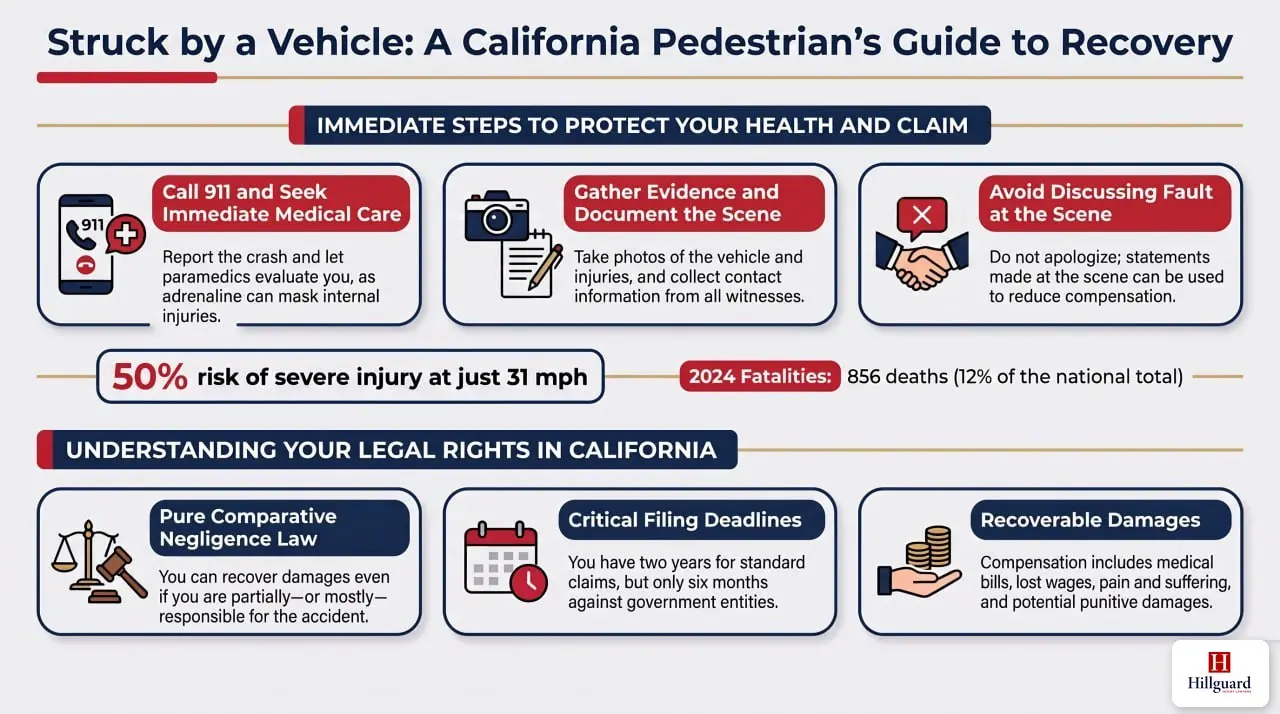
Being struck by a vehicle means a car, truck, or motorcycle hits you while you are on foot. There is no seatbelt or airbag to protect you. The direct impact goes straight into your body. Even a low-speed hit can break bones or cause a head injury. A 50% risk of severe injury occurs at 31 mph.
These crashes happen in places you would think are safe. Crosswalks and intersections are common spots. So are parking lots, where drivers back up without looking. Sidewalks and quiet residential neighborhoods see them too.
School zones are another danger area. Kids dart out, and speeding drivers do not stop in time. California consistently records more pedestrian fatalities than any other state. In 2024, an estimated 856 pedestrians were killed in traffic crashes, accounting for roughly 12% of all pedestrian deaths nationwide, according to the Governors Highway Safety Association (GHSA). Older pedestrians have higher rates of mortality and disability.
What Are the Common Causes of Pedestrian Accidents?
Most pedestrian accidents trace back to driver error. Distracted driving is a huge one. A driver looks at a phone for two seconds and misses you in the crosswalk. Speeding makes it worse, because a fast car needs far more distance to stop.
Failure to yield is another frequent cause. Drivers roll through crosswalks and turn without checking for people on foot. Illegal turns catch pedestrians off guard. So do drivers who run red lights and stop signs.
Alcohol and drugs play a role in many crashes. A driver under the influence has slower reactions and poor judgment. That mix is dangerous for anyone walking nearby. DUI crashes often cause the worst injuries.
Poor visibility adds risk, especially at night. A driver may not see you until it is too late. Backing-up accidents happen in driveways and parking lots. Whatever the cause, the pedestrian almost always pays the price.
What Should You Do After Being Struck by a Vehicle?
The moments after a crash are scary and confusing. What you do next can protect your health and your claim. If you are a pedestrian struck by a vehicle while walking, here are the steps we recommend taking:
Step 1: Call 911
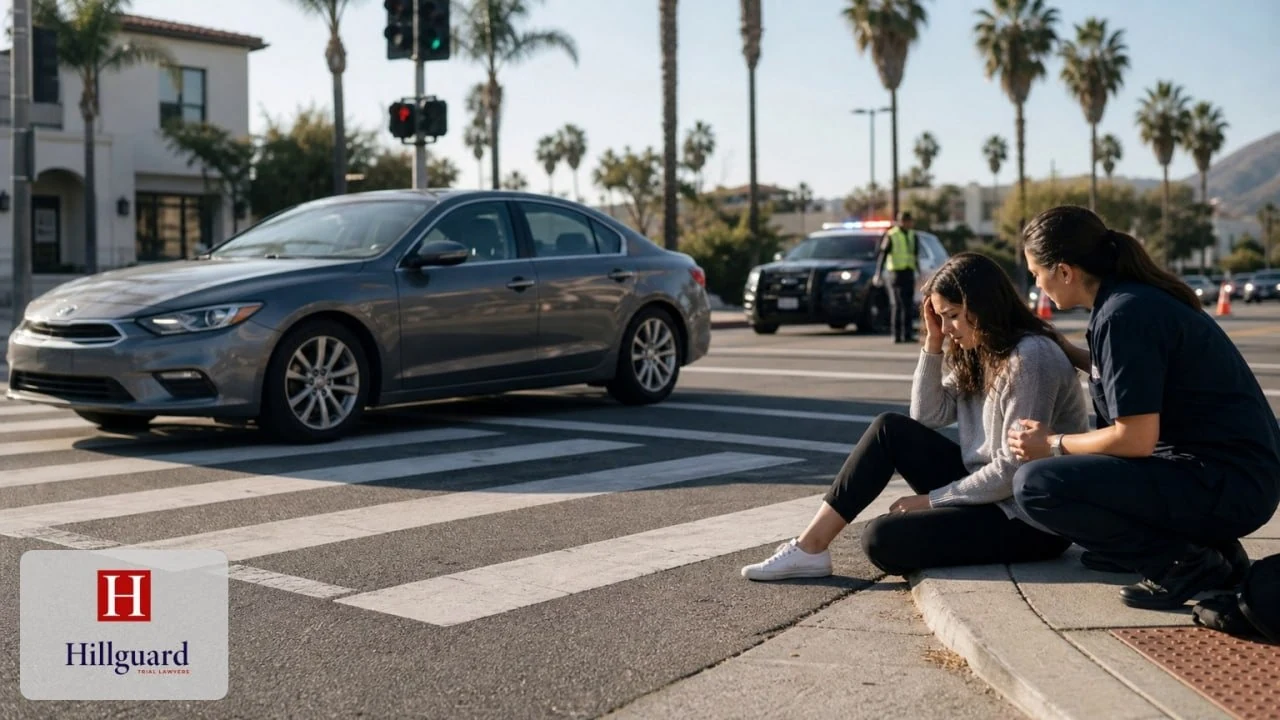
Report the crash right away so police and paramedics come to the scene. The police report creates an official record of what happened.
Step 2: Seek Immediate Medical Attention
Let paramedics check you, even if you feel okay. Adrenaline can mask severe conditions after an accident, making medical evaluation important. Some injuries sustained, like internal bleeding or a concussion, do not show symptoms until later.
Step 3: Move to a Safe Location if Possible
If you can move without pain, get out of traffic to avoid a second hit. Stay close to the scene so you do not miss important details.
Step 4: Gather Evidence
Take photos of the scene, the vehicle, and your injuries. Get the driver's information and the contact info of any witnesses.
Step 5: Report the Accident
Make sure the collision is documented with police, and notify your own insurance company. Stick to the facts and do not guess about what happened.
Step 6: Avoid Discussing Fault
Do not apologize or admit blame at the scene. What you say can be used later to reduce your compensation.
Step 7: Contact a Pedestrian Accident Attorney
A lawyer can protect your rights before you talk to the insurance company. The sooner you call, the more evidence can be preserved.
Comparing Your Options After Being Struck by a Vehicle
Every pedestrian accident claim is different, and the choices you make afterward can affect both your recovery and your compensation. Some options may save time, while others may lead to a better financial outcome. The table below compares common paths injured pedestrians face and the trade-offs to consider before making a decision.
| Situation | Benefits | Trade-Offs |
|---|---|---|
| Accept the insurance company's first offer | You receive money quickly and avoid a lengthy claims process. | Early offers are often lower than what your claim may actually be worth, especially if your injuries worsen later. |
| Hire a pedestrian accident lawyer. | A lawyer can investigate the crash, negotiate with insurers, and pursue maximum compensation. | Legal claims can take longer to resolve, particularly if the case goes to court. |
| Settle your claim | Provides certainty and allows you to move on without litigation. | Once you settle, you generally cannot seek additional compensation for the same injuries. |
| File a lawsuit | May result in a higher recovery when settlement negotiations fail. | Litigation takes more time, requires additional preparation, and the outcome is never guaranteed. |
| Seek medical care immediately | Protects your health and creates medical records that support your claim. | Medical treatment may require time away from work and ongoing appointments, but delaying treatment can seriously hurt both your recovery and your case. |
Common Injuries When a Pedestrian Is Struck by a Vehicle
Pedestrian injuries are often severe because there is no protection. Traumatic brain injuries, or TBI, are among the most serious types. According to the Centers for Disease Control and Prevention (CDC), traumatic brain injury (TBI) is a major cause of death and disability in the United States, with approximately 214,110 TBI-related hospitalizations in 2020 and 68,663 TBI-related deaths in 2023.

Head injuries can change your life in an instant. Spinal cord injuries may lead to lasting nerve damage or paralysis. Broken bones and fractures are common when a motor vehicle strikes a person. Arms, legs, hips, and ribs take the hit. Neck and back injuries can linger for months. Back injuries can result in fractured vertebrae or herniated discs. Internal bleeding is a hidden danger that needs fast medical treatment.
Not every wound is physical. Road rash, lacerations, and soft tissue injuries hurt and take time to heal. Many survivors also suffer psychological trauma, including PTSD. The fear of crossing the street is real after you have been hit. The severity of injuries often depends on the vehicle's speed and the pedestrian's age.
Who May Be Liable When a Pedestrian Is Struck by a Vehicle?
In most cases, the driver who hit you is liable. If they were careless, they can be held responsible for your injuries. That includes speeding, texting, or failing to yield. Proving that negligence is the heart of your claim.
Sometimes more than one party shares the blame. A commercial driver, like a delivery or rideshare driver, may be at fault. When that happens, their employer can also be liable. Company vehicles and work errands often pull an employer into the case.
Government entities can be responsible too. A city may fail to fix a broken signal or a dangerous crosswalk. Poor road design and missing signs can contribute to a crash. Claims against public agencies follow special rules and tight deadlines.
In rare cases, a vehicle defect plays a part. Faulty brakes or a bad backup camera can cause a crash. If a defect contributed, the manufacturer may share liability. A lawyer can look at every angle to find who should pay.
Understanding California Pedestrian Laws
California law puts a real duty on drivers. Under Vehicle Code section 21950, drivers must yield to pedestrians in marked and unmarked crosswalks. That means an intersection does not need painted lines for you to have the right of way. Drivers are also expected to slow down and stay alert near people on foot.
Pedestrians have responsibilities too. You should not suddenly leave a curb into the path of a car that is close enough to be a hazard. You still need to use crosswalks and follow signals where they exist. But a pedestrian's mistake does not erase a driver's duty to be careful.
California follows pure comparative negligence. That means you can recover money even if you were partly, or even mostly, at fault. Your compensation is reduced by your share of the blame. So if you are found 30% at fault, you still recover 70% of your damages.
What Compensation Can an Injured Pedestrian Recover?
The money you can recover depends on how the crash affected your life. Most claims fall into three categories.
Economic damages cover your financial losses. That includes current medical expenses and future medical care. It also covers lost wages and reduced earning capacity if you cannot work as you did before. Rehabilitation and therapy costs count here too.
Non-economic damages cover the human toll. Pain and suffering and emotional distress are part of this. So is loss of enjoyment of life when you cannot do the things you love. Permanent disability, scarring, and disfigurement also belong in this group.
Punitive damages are different, and they are rare. They are not about your losses at all. Courts award them to punish malicious or egregious conduct, like a drunk driver who caused the crash. Most cases never involve them, but the most serious ones sometimes do.
How do Insurance Companies Handle Pedestrian Accident Claims?
After a crash occurs, the driver's insurance company opens an investigation. They review the police report and look at how the collision happened. Adjusters also pull your medical records to check every treatment. Their goal is to decide how much, if anything, they will pay.

Insurers lean hard on comparative negligence. If they can pin part of the fault on you, they pay less. That is why they may argue you stepped out too fast or wore dark clothes at night. Do not be surprised if they try to twist the facts.
Common tactics are meant to shrink your payout. An adjuster may call soon after the crash and sound friendly. They might offer a quick, low settlement before you even know how hurt you are. A lawyer can push back and protect the value of your claim.
What Can Strengthen Your Pedestrian Accident Claim?
Strong evidence is what wins a claim. The police report is a key piece. It records the scene, the driver, and often an officer's view of fault. Get a copy as soon as it is available.
Medical documentation matters just as much. Records tie your injuries directly to the crash. Photographs and videos of the scene tell the story in a way words cannot. Save everything, even images that seem minor at the time.
Witnesses can make or break a case. A neutral witness who saw the driver run the light is powerful. Traffic camera footage can back up your version of events. Both can be lost quickly, so time matters.
Some claims need expert testimony. A crash reconstruction expert can show how the collision happened. A treating doctor can explain your long-term needs. Careful documentation of your financial losses ties it all together.
What Mistakes Should You Avoid After a Pedestrian Accident?
The biggest mistake is delaying any form of medical treatment. If you wait, the insurance company will argue you were not really hurt. See a doctor right away and follow the treatment plan. Your health and your claim both depend on it.
Skipping the police report is another error. Without it, there is no official record of the crash. Failing to report the collision gives the insurer room to deny what happened. Always make sure it is documented.
Watch what you say and post. Sharing details about the accident on social media can hurt you. So can giving a recorded statement to the insurer without legal advice. And never accept an early settlement offer before you know the full cost of your injuries.
How Long Do You Have to File a Pedestrian Accident Claim in California?
California gives you a limited window to file. For most personal injury claims, the statute of limitations is two years from the date of the injury. That deadline comes from Code of Civil Procedure section 335.1. Miss it, and you usually lose the right to sue.
Claims against a government entity are different. If a city or public agency is involved, you must file an administrative claim within six months. That rule comes from Government Code section 911.2. This short timeline surprises a lot of people.
Acting quickly matters for more than the deadline. Evidence fades, cameras record over old footage, and witnesses forget. The sooner you start, the stronger your case tends to be. Waiting rarely helps and often hurts.
How Can a California Pedestrian Accident Lawyer Help You?
A California pedestrian accident lawyer does more than file paperwork. They investigate the crash, gather evidence, preserve surveillance footage, interview witnesses, and identify everyone who may be responsible. They also deal with the insurance company, handle the calls and paperwork, and calculate the full value of your damages, including future medical care, lost wages, and reduced earning capacity.
Consider Sarah, who was struck by a vehicle while using a marked crosswalk in California. After weeks of medical treatment, the driver's insurance company offered a settlement that barely covered her hospital bills. Feeling overwhelmed, she contacted an attorney at Hillguard Injury Lawyers.
Her attorney immediately investigated the collision, obtained traffic camera footage, collected witness statements, and worked with medical experts to document the long-term impact of her injuries. When the insurance company refused to make a fair offer, the attorney continued negotiating from a position of strength and prepared the case for trial. Faced with strong evidence, the insurer agreed to a significantly higher settlement that covered Sarah's medical expenses, lost income, future treatment, and pain and suffering.
While most pedestrian accident claims settle without going to trial, some require litigation to achieve a fair result. Having an experienced trial attorney on your side shows the insurance company that you are prepared to fight for the compensation you deserve. As Christian Kim, a Hillguard Injury Lawyer attorney, explains, "The insurance company starts building its case the day of the crash, so you deserve someone doing the same for you." That allows you to focus on your recovery while your legal team protects your rights every step of the way.
Want to Work With a Pedestrian Lawyer?
Being struck by a vehicle can leave you with serious injuries, unexpected expenses, and uncertainty about what comes next. Knowing your rights is an important first step. California law allows injured pedestrians to seek compensation for medical bills, lost wages, pain and suffering, and other damages. The actions you take after the accident, such as getting medical care, preserving evidence, and reporting the crash, can have a significant impact on your injury claim.
You do not have to face the claims process alone. An experienced California pedestrian accident attorney can investigate the collision, deal with the insurance company, and fight for the compensation you deserve. If you or a loved one has been struck by a vehicle, consider speaking with a lawyer as soon as possible to understand your legal options and protect your rights.
Have you been struck by a vehicle in California? At Hillguard Injury Lawyers, we serve injured pedestrians across California, and our team is led by founding partner David E. Jacobson. Reach out for a free consultation, and let us handle the legal fight while you focus on getting better.
Frequently Asked Questions
If you were struck by a vehicle, you likely have questions about your legal rights, the claims process, and what to expect next. Below are answers to some of the most common questions injured pedestrians have after an accident in California.
What Should I Do Immediately After Being Struck by a Vehicle?
Call 911, seek medical attention, and report the accident to the police. If you can, gather photos, witness information, and the driver's details, and then speak with a pedestrian accident lawyer before talking to the insurance company.
Can I Recover Compensation if I Wasn't in a Crosswalk?
Yes. California's pure comparative negligence law allows you to recover compensation even if you were outside a crosswalk, although your compensation may be reduced based on your share of fault.
What if the Driver Fled the Scene?
Report the hit-and-run to the police immediately and provide as much information about the vehicle as possible. If the driver is not identified, you may still be able to recover compensation through your uninsured motorist coverage.
How Much Is a Pedestrian Accident Claim Worth?
The value of a pedestrian accident claim depends on factors such as your injuries, medical expenses, lost income, future treatment, and pain and suffering. An attorney can evaluate your case and provide a more accurate estimate of its potential value.
How Long Does a Pedestrian Accident Case Take?
The timeline depends on the severity of your injuries and whether the insurance company agrees to a fair settlement. Some claims resolve within a few months, while more complex cases or lawsuits can take a year or longer.
Do I Need a Lawyer After Being Struck by a Vehicle?
You are not required to hire a lawyer, but legal representation can significantly improve your chances of recovering fair compensation. A pedestrian accident lawyer can protect your rights, handle the insurance company, and pursue the full value of your claim.
Disclaimer: This article is for general information only and is not legal advice. Reading it does not create an attorney-client relationship with Hillguard Injury Lawyers. Laws change, and every case is different. For advice about your specific situation, please consult a qualified California personal-injury attorney.