


Most California personal injury lawyers work on a contingency fee, taking roughly 33% of a settlement reached before a lawsuit and around 40% once a case is litigated. What they actually make per case depends on the size of the recovery, the costs advanced, and how far the case goes. So there is no single number; a lawyer’s earnings rise and fall with the result they secure for the client.
Hillguard Injury Lawyers work every personal injury case on contingency, the same fee arrangement this article explains, and founding partner David E. Jacobson has recovered more than $10 million for injured Californians under it. From the firm’s Sherman Oaks office, the team handles practice areas statewide, from car accidents to catastrophic injury, always under a clear written fee agreement that spells out the percentage and the costs. If you want a straight answer about fees before you sign anything, contact us for a free consultation.
This article breaks down how contingency fees work in California, what a lawyer keeps after costs and liens, the limits the law sets, and what really drives how much an attorney earns on any given case.
How California Personal Injury Lawyers Get Paid: The Contingency Fee
Almost every personal injury lawyer in the state works on a contingency fee basis. You pay nothing up front; the fee comes from the money they recover, and if they recover nothing, you owe no attorney fees. People call such an agreement a no-win, no-fee arrangement, the only realistic way most accident victims can hire a lawyer. The costs of hiring a personal injury lawyer differ from most legal fees: they are based on the outcome of the case, making them performance-based rather than fixed-fee.
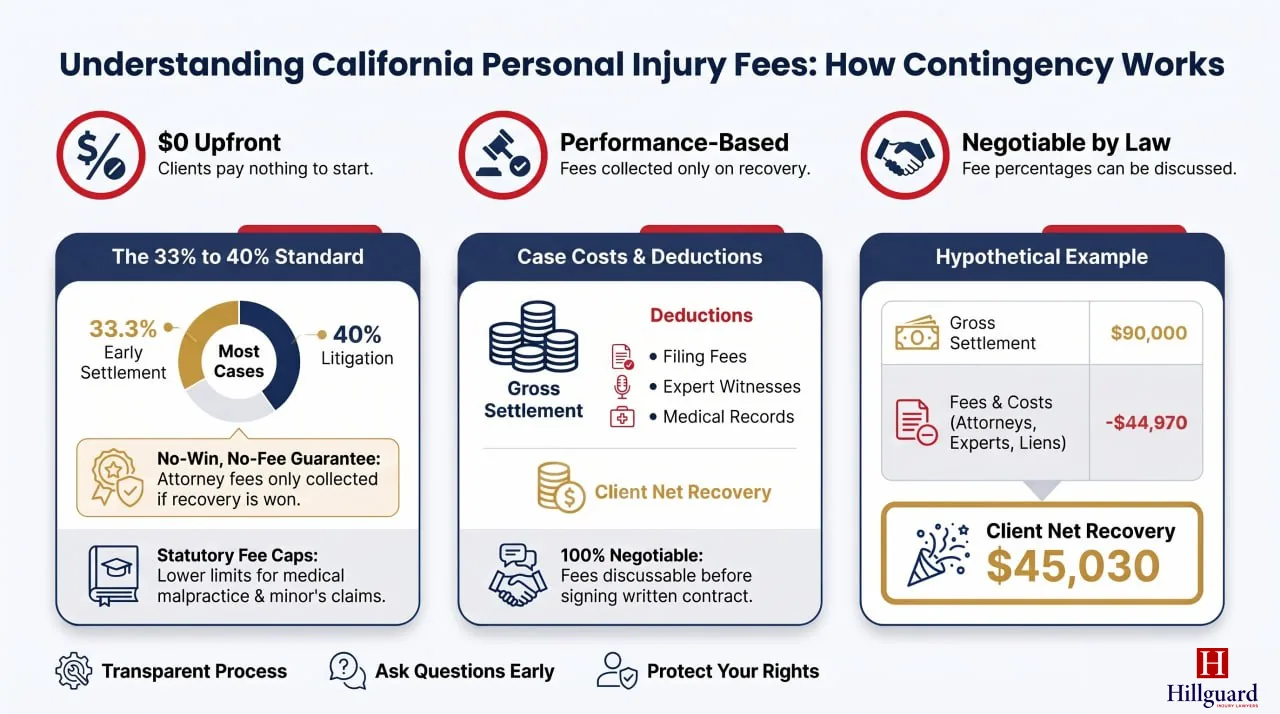
That matters because people who need legal services after a serious injury are often least able to pay by the hour. A contingency fee removes the financial risk at the front door: no upfront fees and no retainer. You pay no upfront costs before a personal injury attorney takes your call. Fee structures can vary by firm and case stage, but the contingency basis remains the same.
Unlike flat fees or an hourly fee, which you pay regardless of outcome, a contingency fee ties the lawyer’s pay to your result. When the claim succeeds, the at-fault party pays through its insurance company, and what reaches you is the recovery minus costs and minus the fee. When someone is hurt by someone else’s negligence, this approach is how most personal injury cases get funded. It starts with a free initial consultation, where the law firm tells you whether you have a personal injury claim worth pursuing and where the attorney-client relationship begins.
What a Contingency Fee Agreement Must Include

California law does not leave the terms to a handshake. Under California Business and Professions Code section 6147, every contingency fee agreement must be a written contract, signed by both the attorney and the client. A deal that fails these rules can be voided at the client’s option.
The written fee agreement has to state the contingency fee percentage the attorney will receive, spell out how litigation costs affect the fee, and disclose that the fee is negotiable. No percentage is fixed by law for an ordinary injury case. Because California law requires that disclosure, you can and should ask about the number before you sign, and a clear fee agreement sets honest expectations about what the legal process will cost.
The Standard Contingency Fee Percentage in California
For ordinary injury work, the standard contingency fee in California falls between 33% and 40% of the recovery. The exact percentage depends on one thing: whether the case settles early or has to be fought through litigation. There is no state cap on it for a standard injury case; the fee is governed by reasonableness and by your written agreement with the firm.
How the Sliding Scale Works
Most personal injury attorneys use a sliding scale written into the fee agreement, and the final percentage hinges on how far the case has to go. Settle with the insurance company before anyone files suit, and the fee usually sits near one-third, about 33.3%. Once a lawsuit is filed and the case moves into active litigation, that tier typically rises to around 40%.
A pre-suit settlement takes less time and carries less risk; a filed case means depositions, motions, and expert work, so the fee tier reflects the added labor. Some fee agreements set a higher percentage for trial or arbitration, given the time those phases demand, but that comes from the contract you sign, not from any California rule, so ask before you agree.
Special Limits: Minors and Medical Malpractice
Two situations carry limits that a typical adult injury claim does not, and they differ from each other.
When the injured person is a minor, a court has to approve any settlement and the attorney fees with it through what is called a “minor’s compromise.” Many California courts limit attorney fees here to about 25% of the minor’s recovery unless a judge approves an exception for good cause, to protect the child’s money.
Medical malpractice cases follow a separate, statutory schedule. Under California Business and Professions Code section 6146, as amended by Assembly Bill 35 effective January 1, 2023, contingency fees in medical malpractice claims are capped at 25% of the recovery if the case settles before a complaint or arbitration demand is filed and 33% if the recovery comes after that filing. An attorney may petition for a higher fee on good cause at trial. These are real statutory limits, separate from the uncapped 33% to 40% range for an ordinary injury case.
The table below sums up how the standard tiers generally line up by stage. Treat these as typical ranges, not promises about your specific case.
| Case stage | Typical contingency fee | Notes |
|---|---|---|
| Settles before a lawsuit is filed | Approximately 33.3% (one-third) | Most common; less time and risk |
| Lawsuit filed, active litigation | Approximately 40% | Reflects depositions, motions, and expert work |
| Goes to trial or arbitration | Higher, by agreement only | By retainer, not a California rule |
| Minor’s claim | Approximately 25%, court-approved | Court-approved minor’s compromise |
| Medical malpractice (pre-complaint) | 25% (statutory) | Capped by Bus. & Prof. Code §6146 (AB 35) |
| Medical malpractice (post-complaint) | 33% (statutory) | The court may allow more for good cause |
What the Lawyer Actually Nets Per Case

Personal injury attorney fees are not the same as what the lawyer pockets. Case expenses come out of a personal injury settlement first, deducted from the recovery, and then any liens are paid before the client sees a check. Gross attorney earnings are not pure profit because the firm usually advances the money to build the case.
Case Costs That Come Off the Top
A personal injury claim costs money long before any settlement arrives. These case costs are separate from the attorney fees. Clients may incur out-of-pocket expenses that include:
- Court filing fees and other court costs
- Expert witness fees for doctors, accident reconstructionists, and economists
- The cost of obtaining medical records and other evidence
- Charges for filing court documents and serving the other party
- Deposition transcripts and the costs incurred in gathering proof of damages
In most California personal injury cases, a California personal injury attorney advances these expenses during the legal process, so clients do not pay them upfront, and the firm is reimbursed from the settlement or verdict at the end. There is a catch: if a personal injury case is unsuccessful, the client may still owe the attorney for advanced costs, depending on the terms of the fee agreement. Many firms write these off as a loss, but not all do, so read that clause. Medical liens add another layer: if a hospital, insurer, or provider treated you on the promise of payment from the settlement, that lien is paid from the gross settlement before you net your share.
A Worked Example
The figures below are hypothetical, used only to illustrate the math, not a prediction of any result.
| Line item | Amount |
|---|---|
| Gross settlement | $90,000 |
| Lower case costs advanced (filing fees, medical records, expert witness fees) | -$3,000 |
| Less contingency fee (33.3%, pre-lawsuit) | -$29,970 |
| Fewer medical liens | -$12,000 |
| Client net recovery | $45,030 |
In this hypothetical, the lawyer’s gross fee is about $29,970, and the $3,000 advance comes back. After office overhead, staff, and the costs incurred on cases the firm lost, the per-case earnings are far smaller than the headline suggests.
What Determines How Much a Lawyer Makes Per Case
No two files pay the same, even at the same percentage. Liability comes first: a clear-fault case settles faster and for more than a contested one. Damages set the ceiling, so a fee on a catastrophic injury is worlds away from one on a soft-tissue claim. Insurance matters too: policy limits often cap what any plaintiff can collect, and insurance companies will not pay beyond the coverage that exists, so a $1 million claim against a $50,000 policy is still a $50,000 claim. Most personal injury lawsuits settle before trial, and litigating moves the fee tier from roughly 33% to 40% while raising the costs and risk that come off the top. Specialization plays a part too: lawyers who concentrate on medical malpractice cases or catastrophic injury cases often earn more per file. And the attorney’s own experience and geographic location shape the picture, the same forces that shape any personal injury lawyer’s salary.
California Personal Injury Lawyer Salary Ranges
Per-case fees roll up into annual income, where misleading numbers start. No government source publishes a “per-case” figure for personal injury work; the only government-grade data covers lawyers as a whole. According to the U.S. Bureau of Labor Statistics Occupational Outlook Handbook, the national median wage for lawyers was $151,160 in May 2024. BLS Occupational Employment data puts the California median lawyer wage at $195,080.
Those are the only hard figures. The tiers below are industry estimates, not government data, and earnings in the personal injury field swing widely with results, firm size, and location. A contingency-firm lawyer has no true salary; income tracks the settlements and verdicts they win. Read these as ballpark estimates, not guarantees.
| Experience level | Estimated annual earnings | What drives it |
|---|---|---|
| Entry-level | $70,000 – $100,000 | Firm size and geographic location |
| Mid-career | $80,000 – $150,000 | More experience; larger, complex cases |
| Senior lawyer or partner | $200,000 – $500,000+ | Track record, specialization, big-city practices |
Experience drives much of that spread: a long track record means bigger, more complex files, and lawyers in large, high-cost California cities generally earn more than peers in rural areas.
Why the Contingency Model Works in Your Favor
The contingency model puts the lawyer’s money on the same side as yours, unlike flat fees or an hourly fee. The contingency fee arrangement aligns the attorney’s financial interest with the client’s outcome: the larger your recovery, the larger the fee. A lawyer billing by the hour collects lawyers’ fees whether you win or lose; a lawyer on contingency gets paid only when you do.
That alignment lets injured people access experienced legal representation without writing a check first: experienced lawyers on your side, with none of the financial risk of paying out of pocket. For accident victims already facing medical bills and lost income, the free consultation costs nothing, and the fee exists only if there is a recovery.
Common Mistakes People Make With Personal Injury Lawyer Fees
Even people who hire a strong lawyer make avoidable mistakes around fees. The most common is not getting the contingency fee agreement in writing; California law requires it, yet clients still rely on a verbal promise. Another is fixating on the contingency fee percentage alone: a firm quoting 33% is not automatically cheaper than one quoting 40%, because case costs and medical liens come off the top. People also forget to ask whether the percentage rises if the case is litigated and then feel blindsided when a filed lawsuit bumps the fee tier.
Many clients assume the fee is fixed. It is not. California law says contingency fees are negotiable, and not asking leaves money on the table. Few think to ask who advances the case costs or what happens to those advanced costs if the case is unsuccessful, even though the answer can leave them owing money after a loss. The costliest mistake is choosing the lowest percentage over experienced legal representation; the right experienced lawyers and their legal expertise can change the size of the result.
How to Review a Personal Injury Fee Agreement Before You Sign

Here is the process we recommend at Hillguard Injury Lawyers before you sign. Our team walks every client through these steps so the numbers are clear up front.
- Start with a free consultation. Ask about fees, costs, and how the firm would handle a case like yours, at no charge.
- Get the contingency fee agreement in writing. A written fee agreement is required by California law; a verbal deal does not protect you.
- Confirm the exact percentage and whether it changes if a lawsuit is filed. Most agreements rise from about 33% pre-suit to around 40% once litigated.
- Ask how case costs are handled and who advances them. Confirm whether the firm fronts filing fees and expert witness fees, and what happens if the case does not succeed.
- Clarify medical liens and how your net recovery is calculated. Know what comes off the gross settlement before money reaches you.
- Confirm the fee is negotiable before you sign the written contract. Under California law, it is, so treat the number as a starting point.
Know What You Are Paying Before You Hire a California Personal Injury Lawyer
How much a California personal injury lawyer makes per case comes down to one thing: the result they win for you. The contingency model means a good attorney only gets paid when you do, and the stronger your recovery, the better you both come out. That alignment is exactly why choosing the right firm matters more than chasing the lowest percentage.
Our experienced personal injury lawyers, led by founding partner David E. Jacobson, represent injured clients across California on a written, no-win-no-fee agreement. Every cost and percentage is explained up front, so you know where your money goes before you commit. Contact us today for a free consultation and a clear breakdown of what representation would cost in your case.
Frequently Asked Questions
We have handled California injury claims for years, on the same contingency fee arrangements covered above. The answers below are general information, not advice about your specific situation.
What Is the Average Income for California Personal Injury Lawyers Per Case?
There is no single figure. Per-case pay tracks the recovery, the costs advanced, and how far the case goes. Industry estimates run from roughly $70,000 for entry-level lawyers to $200,000 to $500,000 or more for senior partners; estimates, not guarantees. No government source reports a per-case number.
How Do California Personal Injury Lawyers Determine Their Fees Per Case?
It is a contingency percentage tied to the case stage, set in a written fee agreement: nearly 33% if the claim settles pre-suit, around 40% once litigated. Case costs and any medical liens are then deducted from the recovery.
What Impact Does Experience Have on a Lawyer’s Earnings?
More experienced lawyers tend to handle higher-value, complex matters like catastrophic injury cases and medical malpractice cases and command higher fees. Geographic location matters too. These are broad patterns, not fixed rules.
How Much Do California Personal Injury Lawyers Typically Charge Per Case?
They usually work on a contingency fee basis, taking a percentage of the client’s settlement or court award. You pay no attorney fees up front; the fee comes from the recovery only if there is one.
What Is the Typical Percentage That California Personal Injury Lawyers Charge?
Typically, 33% to 40% of the final settlement: about 33% if it settles before a lawsuit, up to 40% if litigated. The exact percentage is set in your written agreement.
Are There Any Additional Fees or Costs Associated With Hiring a California Personal Injury Lawyer?
Yes. Beyond the contingency fee, clients may owe case costs like filing fees, court costs, and expert witness fees. Firms usually advance these and recover them from the settlement.
How Do California Personal Injury Lawyers Determine the Value of a Case?
They weigh the extent of the injuries, the impact on the client’s life and ability to work, and the available insurance coverage. Liability and policy limits also shape what a claim can realistically recover.
Is There a Limit to How Much a California Personal Injury Lawyer Can Charge for a Case?
California caps the percentage for certain case types: medical malpractice under section 6146, and cases involving minors require court approval. For ordinary injury cases, there is no statutory cap, but fees must be reasonable and in a written, negotiable agreement. Discuss fees and costs before hiring.
Legal Disclaimer
This article is provided for general informational purposes only and is not legal advice. Reading it does not create an attorney-client relationship with Hillguard Injury Lawyers. Laws change, and how they apply depends on the specific facts of each matter. Fee percentages, costs, and any settlement figures referenced here are general or illustrative and are not a promise or prediction of any outcome; past results do not guarantee future outcomes, and results vary from case to case. For advice about your own situation, consult a licensed California attorney.