

If you hit a pedestrian with a car by accident, you’re not automatically fully responsible for their injuries. Who’s at fault depends on things like negligence, traffic violations, what the pedestrian was doing, the extent of injuries, and the available evidence. Don’t jump to conclusions; instead, report the accident, work with the authorities, and consider talking to a lawyer to understand where you stand.
At Hillguard Law, pedestrian accidents are one of our areas of focus, and we understand how stressful these cases can become. Founding partner David E. Jacobson has over 15 years of experience, and recognition as a 2026 Super Lawyer and National Trial Lawyers Top 100 attorney. Our team can investigate your accident, gather key evidence, handle insurance negotiations, and explain your legal options, so if you are worried about civil liability or what happens next, contact us for a free consultation.
This guide explains what to do after hitting a pedestrian, how fault may be determined, and what legal consequences you might face.
What Should You Do After Hitting a Pedestrian With Your Car?
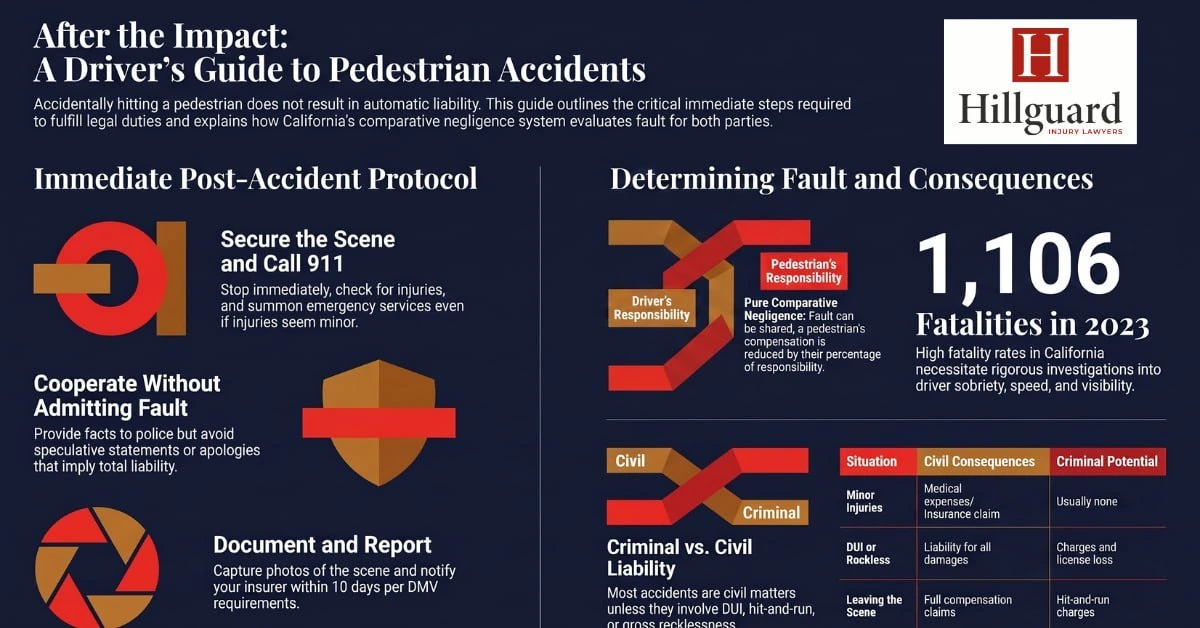
After the Impact
A Driver's Guide to Pedestrian Accidents
Immediate steps and legal considerations after a pedestrian collision in California.
1. Secure the Scene and Call 911
Stop, remain at the scene, check for injuries, and request emergency assistance.
2. Cooperate Without Admitting Fault
Give police accurate facts. Do not guess, apologize, or speculate about liability.
3. Document and Report
Preserve photos, witness details, video, the police report number, and insurance records.
California Comparative Fault
Responsibility may be shared. A person's recovery can be reduced by their assigned percentage of fault.
Civil and Criminal Consequences
Civil claims may seek compensation. DUI, reckless driving, hit-and-run, or a fatal collision may also lead to criminal investigation.
If you have just hit a pedestrian, focus first on preventing further harm. California law imposes duties on drivers involved in injury collisions, and failing to meet those duties can create additional legal problems. Take these five steps while remaining calm and factual.
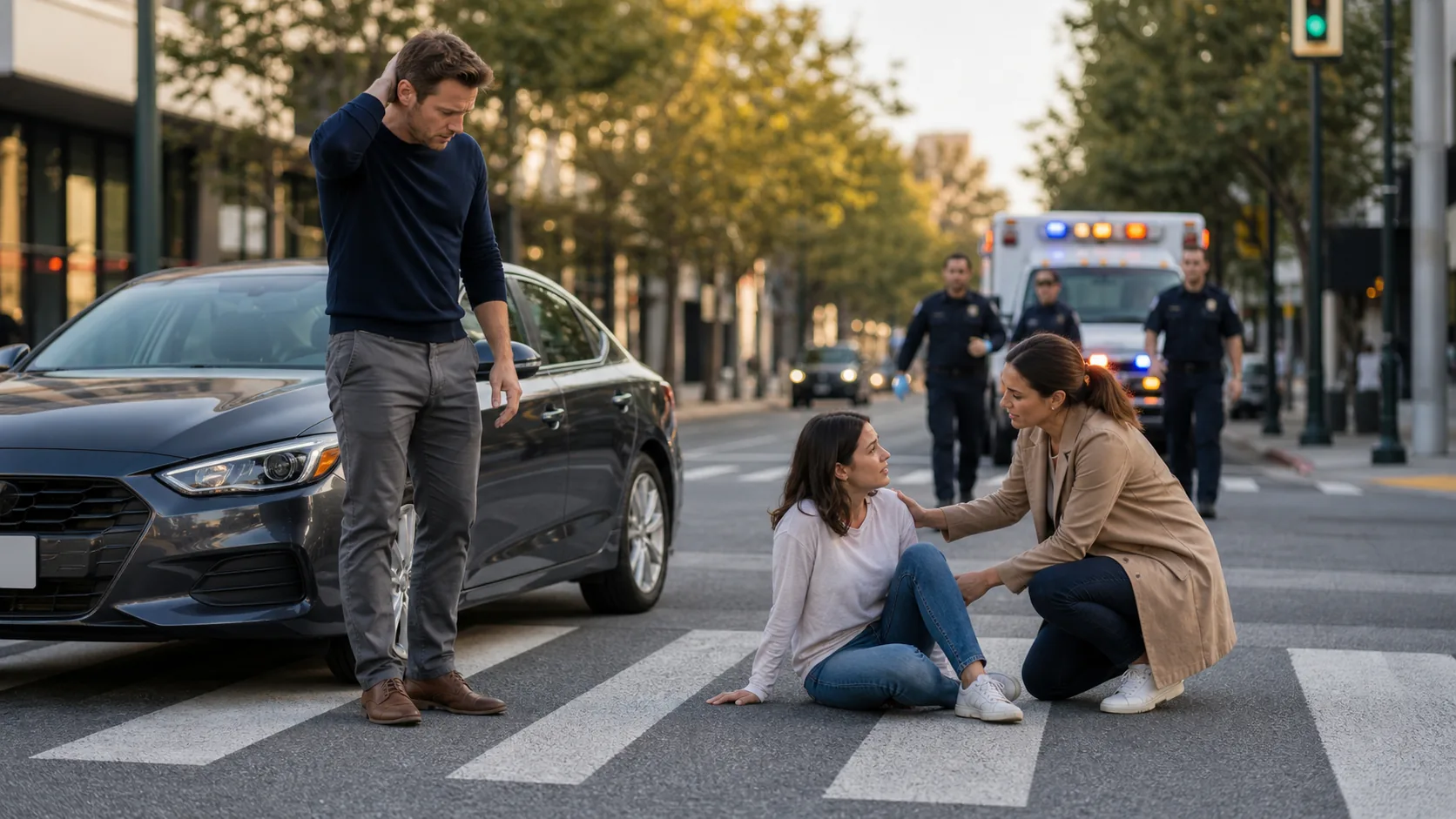
Step 1: Stop Your Car
Stop immediately and remain at the scene. Turn on your hazard lights and, if it is safe, position the vehicle so it does not create another collision risk. Do not leave until law enforcement permits you to do so and you have completed the required exchange of information. Leaving an injury collision may expose a driver to hit-and-run allegations.
Step 2: Check on the Pedestrian
Call 911 and ask for medical assistance. Check whether the pedestrian is responsive, but do not move them unless an immediate danger makes movement necessary. Some head, spinal, and internal injuries are not visible at the scene, so allow emergency personnel to evaluate the person.
Step 3: Cooperate With Police
Provide your license, registration, insurance information, and a truthful account of what you personally observed. Do not guess about speed, distance, visibility, or the pedestrian's actions. Avoid conclusions about fault; police, insurers, and, when necessary, a court will evaluate liability from the available evidence.
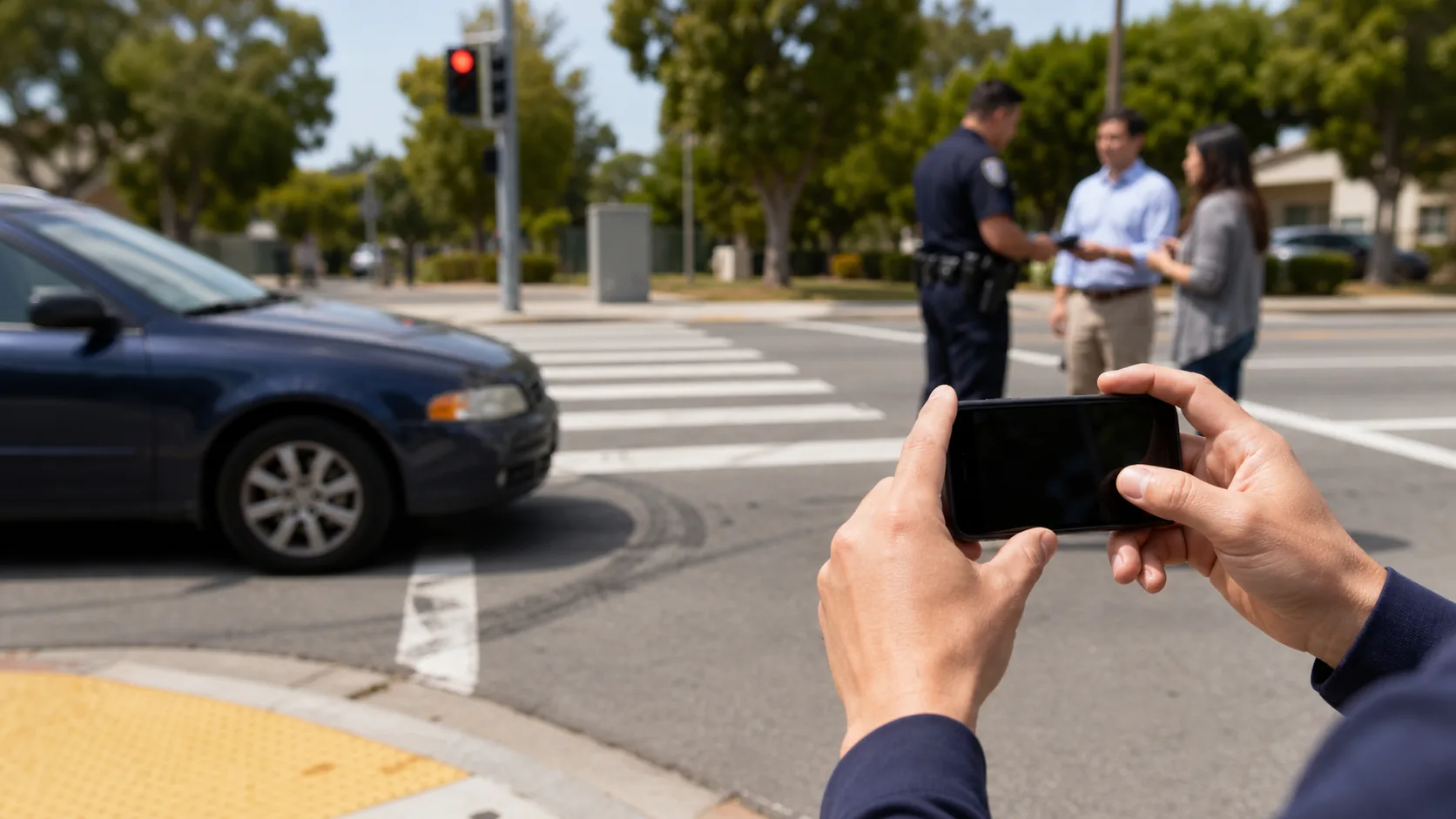
Step 4: Document the Scene
If you can do so safely, photograph the vehicle, crosswalks, traffic signals, signs, road conditions, lighting, skid marks, debris, and visible damage. Obtain witness contact information, preserve dashcam footage, and note nearby businesses or homes that may have security video. Keep the police report number and a written timeline of what happened.
Step 5: Notify Your Insurance
Report the collision to your automobile insurer promptly and comply with reasonable policy requirements. Give accurate facts, but do not admit fault, assign blame, estimate facts you do not know, or make speculative statements about injuries or liability. Before giving a recorded statement or signing a release, consider consulting legal counsel about your rights and policy obligations. This guidance is general information, not legal advice for a particular accident.
Are You Liable if You Accidentally Hit a Pedestrian?
Just because you hit a pedestrian doesn’t mean you’re instantly at fault. Liability often comes down to whether you acted with the care a reasonable driver should. Drivers are expected to watch for pedestrians and do what they can to avoid accidents. Details like road conditions, traffic lights, visibility, what the pedestrian was doing, and your actions right before the incident all play a part.
You might be considered negligent if something you did behind the wheel led to the accident. Things like speeding, distracted driving, not yielding, or running a red light often factor in. You could also be held responsible for not looking for pedestrians while turning, driving under the influence, or not adjusting to bad road conditions. Sometimes it’s not just one mistake, but a combination of actions that adds up to negligence.
Keep in mind, you don’t have to mean any harm to be found negligent. What matters is whether your actions were careless, not your intentions. There’s a legal difference between an unavoidable accident and one caused by reckless or negligent driving.
Can a Pedestrian Be at Fault for Getting Hit by a Car?
If the injured pedestrian was jaywalking, that can impact how fault is divided after an accident occurred, but it doesn’t automatically put all the blame on them. Investigators will still look at whether the driver was speeding, distracted, failed to yield, or could have avoided the collision. The same goes when a pedestrian suddenly steps into the road; things like speed, visibility, traffic, and the driver’s reaction time all come into play.
California follows pure comparative negligence under California Civil Code section 1714, which allows responsibility to be divided between the people involved. For example, if proven damages total $100,000 and the pedestrian is found 30% responsible, the pedestrian's recovery may be reduced by that share to $70,000. These figures illustrate the comparative-fault calculation; they are not average settlements or a prediction of any case outcome.
So, figuring out fault after a pedestrian accident isn’t as simple as asking who was hit. Police reports, witness statements, traffic-camera footage, and vehicle damage all help paint the full picture. If both sides share some blame, their actions can directly affect how much compensation is available.
What Are the Legal Consequences of Hitting a Pedestrian?
Pedestrian collisions can have severe consequences. The California Office of Traffic Safety reports that 1,106 pedestrians were killed in California traffic collisions in 2023. That figure represents statewide pedestrian fatalities for that year; it is not a case estimate. When a pedestrian survives, potential civil damages may include medical expenses, future care, lost income, and pain and suffering, depending on the evidence and each party's share of fault.
Not every accident leads to criminal charges. But if the crash is fatal, involves alcohol, reckless driving, a hit-and-run, or a serious traffic violation, you could face serious consequences. You might also get traffic tickets, points on your record, or even lose your license. These penalties are separate from civil claims, so one accident can mean both legal and financial trouble.
If the pedestrian dies, the situation can become significantly more serious. Law enforcement may investigate the collision, and prosecutors could consider criminal charges based on the driver's conduct and the circumstances surrounding the death. The pedestrian's family may also have grounds for a wrongful death claim seeking compensation for eligible losses. Because the consequences can vary substantially, evidence showing the driver's speed, sobriety, traffic violations, visibility, and actions before the collision can be critical when determining what happened.
Accident Outcome vs. Potential Consequences
The consequences depend on the injuries, the driver's conduct, the available insurance, and how fault is allocated. The table summarizes common possibilities without predicting the outcome of a particular case.
| Accident Outcome | Potential Consequences |
|---|---|
| No apparent injury at the scene | The driver must still stop, exchange information, document the collision, and follow applicable reporting rules. A delayed injury claim remains possible. |
| Minor injuries | A bodily injury claim may seek emergency care costs, follow-up treatment, limited lost wages, and other supported damages. Insurance premiums or the driving record may also be affected. |
| Serious or permanent injuries | Exposure may include hospitalization, surgery, rehabilitation, future medical care, lost earning capacity, and non-economic damages. Losses above policy limits may create personal financial exposure. |
| Shared fault | Under California’s comparative-negligence rules, damages may be reduced by the injured person’s assigned percentage of fault. |
| DUI or reckless driving | Civil liability may be accompanied by criminal investigation, fines, incarceration, license consequences, and possible punitive-damages allegations where legally supported. |
| Hit-and-run | Leaving the scene may lead to hit-and-run charges and license consequences in addition to a civil injury claim. |
| Fatal collision | The family may pursue a wrongful-death claim, while law enforcement and prosecutors determine whether criminal charges are warranted by the driver’s conduct. |
What Happens if the Pedestrian Walks Away Without Injuries?
A pedestrian can also develop symptoms hours or days after a collision. Some injuries may not be obvious immediately, so saying they feel fine at the scene does not necessarily end the matter. As David E. Jacobson, Hillguard’s founding partner, explains, “A pedestrian walking away from an accident does not necessarily mean there is no injury. You may still need to stay at the scene and document what happened." If the pedestrian later seeks treatment, they can decide to file a claim for their medical expenses.
To protect yourself, follow the appropriate reporting requirements. In California, the Department of Motor Vehicles (DMV) requires a Traffic Accident Report within 10 days when someone is injured, even if the injury appears minor.
If the pedestrian insists they’re okay, still exchange contact and insurance details and follow all reporting rules. Take photos, save any video, police report and jot down what happened while it’s fresh in your mind. Notify your insurance company right away and keep all records. Don’t offer cash, promise to pay out of pocket, or ask the pedestrian to waive a claim. Those actions can make you look guilty.
What Are the Most Common Pedestrian Accident Injuries?
A pedestrian may sustain injuries even when symptoms are not immediately visible. Prompt medical evaluation is important because delayed treatment can affect both health and the documentation of an insurance or legal claim.
Traumatic Brain Injuries
A blow to the head or the force of impact can cause a concussion or more serious traumatic brain injury. Warning signs include headache, confusion, dizziness, nausea, memory problems, vision changes, or loss of consciousness.
Broken Bones
Vehicle impact or contact with the pavement can fracture the legs, arms, ribs, pelvis, wrists, or facial bones. Treatment may involve immobilization, surgery, rehabilitation, and time away from work.
Spinal Cord
Trauma to the neck, back, or spinal cord may cause pain, numbness, weakness, limited movement, or paralysis. These injuries can require surgery, rehabilitation, mobility equipment, and long-term medical care.
Internal Injuries
Damage to organs or internal bleeding may occur without an obvious external wound. Abdominal pain, swelling, dizziness, weakness, fainting, or unusual bruising requires urgent medical attention.
Soft Tissue
Sprains, strains, contusions, and other injuries to muscles, ligaments, and tendons can cause pain, swelling, stiffness, and reduced mobility. Symptoms may worsen in the hours or days after the collision.
Psychological Trauma
A pedestrian collision may also cause anxiety, nightmares, sleep disruption, fear of traffic, depression, or post-traumatic stress symptoms. Counseling and other mental-health treatment may form part of the person's recovery and documented damages.
How Is Fault Determined After a Pedestrian Accident?
Figuring out who’s at fault in a pedestrian accident involves more than just asking how the accident happened. Police reports, witness accounts, CCTV or dashcam footage, and things like traffic signals and crosswalks are all considered to help paint the picture. Investigators will also check for vehicle damage, skid marks, weather and road conditions, and medical records. Taken together, these details reveal where everyone was, how the car was moving, and whether the accident could have been avoided.
Independent witnesses are especially helpful. They’re neutral and can offer a fresh perspective. A witness might recall the color of the light, describe how the pedestrian moved, estimate the car’s speed, or talk about visibility. If someone saw the accident, try to get their name and contact info if it’s safe.
Insurance companies take a similar approach when figuring out fault. They compare everyone’s statements, like the driver, pedestrian, and witnesses, against the police report, physical evidence, traffic laws, and medical records. People can remember the same event differently, and sometimes the evidence tells a different story than what someone first said.
Does Car Insurance Cover a Pedestrian You Hit?
If you hit a pedestrian, your car insurance might help cover their injuries if you’re found at fault. This usually includes the pedestrian's medical bills and some related losses, depending on your policy. But insurance coverage isn’t automatic; the company will first look into what happened.
As Christian H. Kim, Trial Attorney at Hillguard, puts it: “Your insurance may cover a pedestrian’s injuries, but the policy limits and circumstances of the accident can determine how far that coverage goes.” When a pedestrian files a claim, the insurer reviews the accident report, statements, injuries, and damages before trying to settle.
If you disagree with the insurer about who’s at fault or how much should be paid, you can push back. Sometimes, stories conflict, or evidence is missing, which can influence how the claim is handled. If the pedestrian’s losses go over your policy limits, your insurance may not cover everything, meaning you could be personally responsible for the rest. Since every policy and situation is different, it’s smart to talk with a lawyer before making big decisions.
Can a Pedestrian Sue You After You Accidentally Hit Them?
Yes, a pedestrian can sue you. Even if it was an accident and you never meant to hurt anyone. If your negligence caused the crash and led to injuries, medical bills, lost wages, or other losses, the pedestrian might file a personal injury claim. To succeed, they’ll need to show evidence linking your actions to their injuries. And if the pedestrian shares some blame, California’s comparative negligence rules may just lower their compensation instead of blocking it entirely.
If insurance talks fail, the pedestrian might make a formal demand, try to settle, or go straight to a lawsuit. The case then goes through discovery where both sides gather evidence and may settle, or head to trial if there’s still no agreement.
For example, imagine a driver who accidentally hits a pedestrian while turning at an intersection and stops right away to help. When negotiations fell through, the pedestrian sued, and the driver called Hillguard. Our attorneys dug into the police report, traffic signals, witness statements, and video footage, and found evidence supporting the driver’s side of the story. We told the driver not to comment further about fault while we challenged the pedestrian’s claims and damages. That approach helped us reach a much better outcome than just accepting the pedestrian’s initial demand.
This is a hypothetical example, but it shows how Hillguard approaches these situations.
How Can a Car Accident Lawyer Help After Hitting a Pedestrian?
If you’ve hit a pedestrian, it’s a good idea to talk to a lawyer; especially if injuries are serious, fault is unclear, or you’re being accused of negligence. Legal help is also crucial if the pedestrian died, your insurance company is pushing back, or the police are investigating possible criminal charges. Big damages can put your personal assets at risk, too. Getting a lawyer involved early helps you understand your situation before you say or do anything that could hurt your case.

A California pedestrian accident lawyer can dig into the details, gather key evidence, and figure out who’s really at fault. They’ll review California law, look at the pedestrian’s claims, and spot holes in the other side’s story. Your lawyer can talk to insurers for you, challenge blame or damages, and negotiate a fair settlement. If things can’t be worked out, they’ll take your case to court and fight for your interests every step of the way.
Do You Need a Personal Injury Lawyer?
Accidentally hitting a pedestrian can be very frustrating. It will leave you facing medical claims, insurance disputes, questions about fault, and potential legal consequences. But an accident does not automatically make you liable, and the outcome can depend on evidence, driver conduct, pedestrian actions, visible injuries, and California's comparative negligence rules. Taking the right steps after the collision, documenting the scene, reporting the accident, and communicating carefully with insurers can protect your legal position.
If you are facing a personal injury lawsuit, you do not have to handle the process alone. A personal injury lawyer can investigate the accident, provide legal representation, review the evidence, assess fault, communicate with insurance companies, and challenge claims that are not supported by the facts.
If you or a loved one has been involved in a pedestrian accident, consider contacting an experienced California personal injury attorney for guidance on the legal process. At Hillguard Law, we know how overwhelming a pedestrian accident can feel, both legally and financially. Our team in California will look over your situation, walk you through your options, and help you figure out the best steps to protect yourself. If you’ve hurt someone in a pedestrian accident, reach out to us for a free case review.
Frequently Asked Questions
Hitting a pedestrian can be frightening, especially because you’re unsure of what happens next. You might be wondering about your legal duties, insurance, who’s at fault, and what could happen. Here are answers to some of the most common questions drivers face after a pedestrian accident.
What Should I Do if I Hit a Pedestrian With My Car by Accident?
If you hit a pedestrian, stop right away and stay at the scene. Check if the person needs medical care and call 911 if needed. Cooperate with the police, document everything, and don’t admit fault until you know what really happened.
What Legal Obligations Do I Have After Accidentally Hitting a Pedestrian?
California law requires you to stop at the scene, share your information, and help anyone who’s hurt. You also have to follow all reporting rules. If you leave before doing these things, you could face hit-and-run charges.
Will I Go to Jail if I Accidentally Hit a Pedestrian?
Not necessarily. An accidental collision does not automatically lead to jail, but DUI, reckless driving, hit-and-run, or a fatal collision can result in criminal charges.
Can I Be Sued for Accidentally Hitting a Pedestrian?
Yes. A pedestrian can sue if they suffered injuries or other losses and believe your negligence caused the accident. However, an accident does not automatically make you liable.
What if the Pedestrian Was Jaywalking?
If the pedestrian was jaywalking, their conduct may reduce their share of compensation under California’s comparative negligence rules. However, jaywalking does not automatically make them fully responsible, since the driver’s actions and other circumstances are also considered.
What if the Pedestrian Walks Away and Says They Are Not Injured?
You’re still expected to stop, exchange information, document the accident, and follow California’s reporting requirements. A pedestrian may develop symptoms later, so their initial statement that they are not injured does not necessarily prevent an injury claim later.
Will My Insurance Cover the Pedestrian’s Injuries?
Your bodily injury liability coverage may help pay for the pedestrian’s injuries if you are legally responsible for the accident. Coverage depends on your policy, limits, and the circumstances, so check with your insurer or a lawyer before assuming everything is covered.
Disclaimer: This blog provides general information about pedestrian accidents and California law. It is not legal advice and does not create an attorney-client relationship with Hillguard Law or any of its attorneys. Every accident is different, and the laws that apply depend on the specific facts of your case. For advice about your situation, consult a qualified California attorney.