

Dog attack compensation in California typically ranges from about $30,000 to $200,000 or more for cases that settle, with the Insurance Information Institute reporting the national average dog bite homeowner's claim payout at roughly $65,450. Severe cases, including catastrophic mauling and wrongful death, can reach into the seven-figure range; multi-million-dollar settlements are uncommon but do occur where injuries are permanent and policy limits or personal assets allow. The dollar value of any specific case depends on the severity of the injuries, the medical treatment required, lost wages, and the emotional trauma the victim is left with.
Hillguard Injury Lawyers has years of experience representing California dog bite victims and other dog attack victims, and pursuing fair compensation through homeowner's, renter's, and umbrella insurance carriers. Our dog bite injury attorneys build the medical, financial, and liability evidence that supports the upper end of the range available under California dog bite law and the negligence framework that covers non-bite injuries. Contact us today for a free consultation about your legal rights and the legal help available.
This article walks through what counts as a dog attack under California law, the two legal pathways for recovery, the categories of compensation available, who pays, how cases are valued, and how long you have to file.
What Counts as a Dog Attack in California?
A "dog attack" covers a broader category of injuries than the term "dog bite." Most cases involve an actual bite, but California courts and insurers regularly compensate other forms of injury caused by an out-of-control dog. The categories that come up most often:
- Bite wounds, including punctures and lacerations from a single bite or multiple bites
- Knock-down injuries when a dog jumps, charges, or pulls a victim off balance
- Crush and tissue damage in mauling cases involving sustained attacks
- Scratches and abrasions deep enough to cause infection or scarring
- Attacks that cause significant emotional trauma even where physical injury is relatively minor
- Attacks resulting in wrongful death
The legal pathway depends on which category the injury falls into, which is the first thing a California dog bite attorney looks at when reviewing a case.
How California Law Approaches Dog Attack Compensation
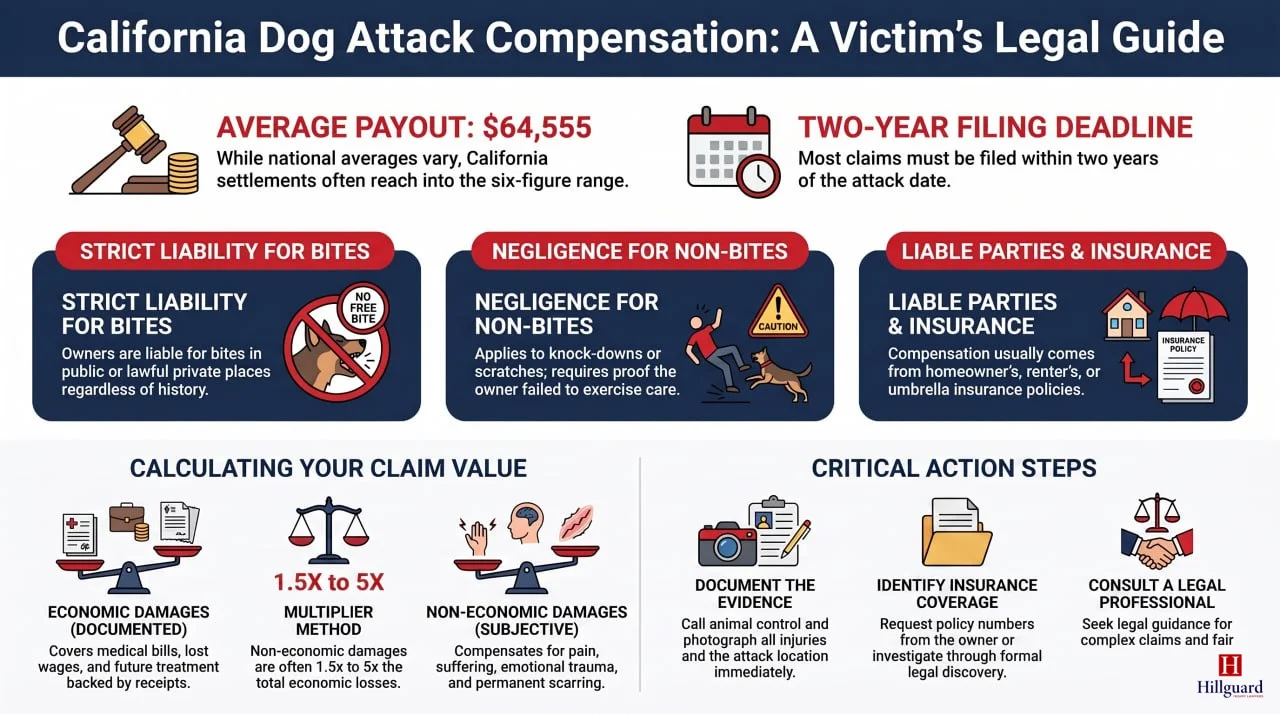
California uses two separate legal frameworks for dog attack cases. Bite injuries are governed by a strict-liability statute. Non-bite injuries are pursued under a negligence theory. The two pathways differ in what the victim has to prove and in how the insurance carrier defends the case.
The table below summarizes the difference.
| Factor | Strict Liability | Negligence |
|---|---|---|
| Type of injury | Actual bite | Knock-downs, scratches, crush injuries, and other non-bite harm |
| What the victim must prove | The bite occurred while the victim was in a public place or lawfully on private property | The dog owner failed to use reasonable care to control or restrain the animal |
| Owner's prior knowledge of viciousness | Not required | Often relevant (whether owner knew or should have known) |
| Common defenses | Trespassing, provocation, veterinarian's rule, professional handler | Same defenses plus the standard negligence defenses |
| Liability of the dog owner | Direct, regardless of past behavior | Tied to the owner's conduct and knowledge |
Under California Civil Code §3342, a dog owner is held liable for injuries caused by their dog if a bite occurs in a public place or while the victim is lawfully on private property (including the dog owner's property), regardless of the dog's past behavior or any prior knowledge of viciousness. There is no "one free bite" for a dog in California; the statute applies the first time, and every time after.
For non-bite injuries, the victim files a standard negligence claim, which requires proof that the owner failed to use reasonable care to restrain or control the animal. That can include leash law violations, knowingly letting a dog with a history of aggression run loose, or failing to keep a fence in working condition.
A common scenario is a person knocked down because a large dog jumped on them. Even without a bite, the dog owner's behavior and failure to control the animal can support a dog bite claim brought as a negligence action, sometimes called a dog bite lawsuit in informal usage. If the dog has previously bitten or attacked someone, California law expects the owner to take reasonable steps to prevent it from happening again, and failure to do so can lead to increased liability. An owner who is financially responsible for the dog (under both legal and practical insurance terms) is the most common defendant in these cases.
The strict-liability protection has two well-defined limits. First, you cannot collect strict-liability compensation if you were trespassing or committing a crime on the owner's property at the time the attack occurred. Second, under the so-called "veterinarian's rule" first applied in Nelson v. Hall, 165 Cal.App.3d 709 (1985), professionals who work with dogs (veterinarians, vet techs, groomers, professional dog walkers, pet sitters, kennel staff) may be barred from strict-liability recovery based on accepting the occupational risk. Those cases can still proceed under negligence if the owner concealed a known danger.
Common Dog Attack Injuries
The injuries that drive dog attack claims tend to fall into a few categories:
- Bite wounds and puncture wounds requiring stitches, wound care, and antibiotic treatment
- Deep lacerations and crush injuries from a mauling attack
- Broken bones from being knocked down or pulled by a large dog
- Nerve and tendon damage that affects long-term function
- Permanent scarring and disfigurement, especially on the face, hands, and exposed skin
- Infections, including rabies exposure, where the dog's vaccination status is unknown
- PTSD, anxiety, and other psychological trauma are especially common in child victims
- Catastrophic injuries leaving the victim permanently disabled
- Fatal attacks (rare but tragic)
The severity of the physical injuries, combined with the emotional and psychological trauma and any ongoing therapy required, drives the compensation a victim can recover damages for. Dog bite injuries in particular tend to carry both physical and psychological consequences that last well past the initial wound.
Compensation Available for Dog Attack Victims

California law allows injured victims of dog attacks to receive two types of compensatory damages: economic damages and non-economic damages. The first category covers losses you can document with receipts; the second covers losses that are real but have no invoice. The table below breaks down the recoverable damages on each side.
| Economic Damages | Non-Economic Damages |
|---|---|
| Medical expenses (emergency care, hospital, surgery) | Pain and suffering |
| Future medical treatment and physical therapy | Emotional distress and psychological trauma |
| Out-of-pocket expenses (medication, equipment, transport) | Permanent scarring and disfigurement |
| Wages lost during recovery | Loss of enjoyment of daily life |
| Lost earning capacity from permanent disability | Anxiety, PTSD, and ongoing emotional trauma |
Wrongful death damages are available under California Code of Civil Procedure §377.60 when a dog attack results in the victim's death. Surviving family members, typically a spouse, children, or other heirs, can pursue these recoverable damages on the decedent's behalf.
In rare cases involving gross negligence, the conduct can also support punitive damages under California Civil Code §3294, which applies when the owner's conduct is proven by clear and convincing evidence to involve oppression, fraud, or malice. A knowingly dangerous dog allowed to roam freely after prior attacks is the type of scenario where punitive damages may come into play.
How Dog Attack Compensation Is Calculated
There is no fixed formula a California court hands out, but most claims are built the same way. Start with the documented economic damages, medical expenses, wages lost, future treatment, ongoing therapy, and any other out-of-pocket expenses backed by paperwork. Add an estimate for future medical care if surgery or rehabilitation is anticipated. Then estimate non-economic damages, which insurance carriers and personal injury attorneys commonly calculate using a multiplier method: total economic damages multiplied by a factor between 1.5 and 5, depending on the severity of injuries and the permanence of the harm. Finally, measure the total against the available insurance, because a claim worth more than the policy ceiling usually settles at the limit unless additional assets are reachable.
More severe cases, including those involving permanent disability or wrongful death, can produce dramatically higher figures. The Insurance Information Institute reports that average per-claim costs have risen substantially over the past decade as medical and reconstructive costs have climbed.
Who Is Liable for a Dog Attack in California?
The starting point is usually the dog owner, but more than one party can share liability depending on the facts.
- The dog owner. The default liable party in both strict-liability and negligence cases.
- Keepers, handlers, and pet sitters. A non-owner in control of the dog at the time of the attack can be held liable under negligence principles if they failed to use reasonable care.
- Landlords and property owners. A landlord can be held liable in limited circumstances where they had actual knowledge of a dangerous dog on the property and failed to act. A property owner with control over the premises may also share liability.
- Public entities. When the attack involves a county or city dog (such as a police dog) or occurs on public property and a government entity bears some responsibility, a claim against the public entity is possible. A formal claim under California Government Code §911.2 must be filed within six months of the incident, before any lawsuit can be brought.
A thorough investigation identifies every potentially liable party and every applicable insurance policy. That work, more than anything else, determines what an injured victim can actually recover.
Who Pays Dog Attack Compensation?
The owner is legally responsible, but the payment usually comes from insurance.
- Homeowner's insurance. The most common source. Standard policies include liability coverage of $100,000 to $300,000 for animal-related claims.
- Renter's insurance. Works the same way when the owner rents rather than owns.
- Umbrella insurance. Sits on top of the underlying policy and can add $1 million or more in coverage. Critical in serious-injury or wrongful-death cases.
- Personal assets. When the owner is uninsured, or the injury exceeds available coverage, the recovery comes from the owner personally. That is harder to collect and is often what limits the total payout.
Most dog attack claims are resolved by filing directly with the dog owner's insurance company. That carrier's adjuster opens an investigation, requests medical records, and either pays the claim or disputes it. If the carrier disputes liability or undervalues the case, the next step is litigation.
How to Document a Dog Attack
The quality of the documentation in the first few days after an attack often determines what the case is worth months later. Practical steps an injured person or family member should take:
- Get emergency care immediately. Treat any bite or wound as potentially serious; rabies and infection risk both rise with delay. Same-day medical care also creates a contemporaneous record that ties the injury to the attack.
- Call animal control. A call to animal control creates an official record of the attack, triggers an investigation, and can capture the dog's vaccination history. The animal control report is often the single most useful document in the file.
- Photograph everything. Photograph the injuries (with a ruler or date stamp where possible), the location, any torn clothing, and the dog if it can be done safely. Keep taking photos as the wound heals so the scar and treatment progression are documented.
- Get the owner's information. Name, address, phone, and the dog owner's insurance company and policy number, where possible.
- Identify witnesses. Anyone who saw the attack or saw the dog's behavior before it happened. Names, phone numbers, and written or recorded statements where you can get them.
- Preserve prior knowledge evidence. If neighbors had complained about the dog, if there were prior animal control reports, or if the owner had been warned, gather what you can. Prior knowledge of viciousness matters in negligence claims and supports punitive damages in rare cases.
- Keep your medical records. Every emergency room visit, follow-up appointment, surgery, prescription, physical therapy session, and ongoing therapy referral.
- Track lost wages. Pay stubs, employer statements, and any documentation of lost earning capacity if the injury is severe enough to affect long-term work.
How Long Do You Have to File a Dog Attack Claim in California?
California's two-year statute of limitations applies to most personal injury claims, including dog attack claims, under Code of Civil Procedure §335.1. The clock starts on the date of the attack. Miss the deadline, and the court can throw the case out regardless of how clear the liability is.
Two narrower windows apply:
- Claims against a public entity require a formal government claim within six months of the incident (Government Code §911.2) before a lawsuit can be filed.
- Claims on behalf of minors can be tolled until the minor reaches the age of majority, but waiting that long is rarely the right call because evidence and witnesses are easier to find sooner rather than later.
How a California Dog Attack Lawyer Affects the Compensation You Recover

Most of the work in a dog attack case is investigation and documentation. An experienced attorney pulls together the medical records, the photographs, the animal control report, and the witness statements that prove the injury and the liability. The attorney also finds every insurance policy that might apply (homeowner's, renter's, umbrella, employer, if applicable) and ties the injury to the attack so the carrier cannot wave it off as unrelated. When the insurer argues provocation, trespass, or the veterinarian's rule, the answer is evidence: where the attack occurred, what the victim was doing there, and what the dog's prior behavior had been.
Most California dog bite cases settle without trial. The ones that do not are typically the cases where the insurer disputes liability or lowballs a serious injury, and those are the cases where having an experienced attorney ready to file changes what the carrier is willing to pay.
Ready to Talk to a California Dog Attack Lawyer
A dog attack case is built on documentation, liability evidence, and finding every dollar of insurance the owner carries. Working with an experienced attorney gives you the best chance of recovering the full value of your medical expenses, lost wages, pain and suffering, and ongoing therapy costs the law allows. Hillguard Injury Lawyers handles California dog attack cases on a contingency basis: no fee unless we recover for you.
Our team includes an experienced dog bite injury attorney who has represented dog attack victims across Los Angeles and the surrounding counties. We investigate the attack, identify every liable party, and prepare every case as if it could go to trial, because that is what moves the carrier's number. Contact us today for a free, confidential review of your legal options.
Frequently Asked Questions
Here are answers to some questions we encounter as we represent dog attack victims in California.
Is a Dog Attack the Same as a Dog Bite Under California Law?
No. California Civil Code §3342 strict liability applies only to bites. Non-bite injuries (knock-downs, scratches, crush injuries) are pursued under negligence, which requires proof that the owner failed to use reasonable care to control the dog. Both pathways can produce recoverable damages, but the proof requirements differ.
What if I Was Knocked Down but Not Bitten?
You can still file a claim. A non-bite injury falls under a negligence framework rather than strict liability, so you have to show the owner failed to use reasonable care (for example, by violating a leash law, knowingly letting a dog with a history of aggression run loose, or failing to maintain a fence). Many cases involving a dog that jumped, charged, or pulled a person down succeed under this theory.
Does Homeowner's Insurance Cover All Dog Attacks?
Usually, yes. Most homeowners' and renters' policies include animal-liability coverage. Some carriers exclude certain breeds; some apply lower sub-limits for dog-related claims. Always check the policy early to know what coverage is available.
Can I Sue if My Child Was Attacked?
Yes. Claims involving children often carry higher value because permanent scarring and lasting psychological trauma are treated as lifelong harm. A settlement for a minor in California has to be approved by the court before it can be paid, which adds a procedural step but protects the child's recovery.
How Long Does a Dog Attack Claim Take?
Straightforward cases can settle in a few months. Cases involving severe injuries, disputed liability, or a child often take a year or more. Cases that go to trial take longer, but the additional time often produces a higher settlement before trial begins.