

Most car accident lawyers in California charge a contingency fee, typically 30% to 40% of the recovery, with no money owed up front. The percentage varies by case stage, approximately 33% before suit, 35–40% after filing, and 40–45% at trial. California Business and Professions Code §6147 requires the agreement to be in writing, and no statutory cap applies to contingency fees for car accidents.
Hillguard Injury Lawyers have years of experience pursuing California car accident claims against major insurance carriers. Our car accident lawyers work on contingency — no fees unless the case recovers, with case expenses advanced under the agreement. Contact us for a free case review.
This blog breaks down the percentage ranges, case expenses, the written-agreement rules under California law, common fee mistakes, and the line items that change your net check.
How Most California Car Accident Lawyers Charge: The Contingency Fee Model
A contingency fee is straightforward. The lawyer's fee is based on a percentage of the recovery amount, and there are no upfront costs for the client. Many car accident lawyers in California operate on a contingency fee model because most accident victims are unable to pay for legal services while they are recovering from their injuries.
The contingency fee system transfers the financial risk to the firm, meaning no fee is owed if there is no recovery. This is how car accident lawyers work for the vast majority of California personal injury claims and other personal injury cases. The settlement amount or court award is the pool the percentage comes out of.
Additionally, personal injury lawyers charge a percentage at the back end. Personal injury lawyer cost at intake is effectively zero, which is why the contingency fee arrangement dominates car accident representation. Most car accident lawyers in California charge a contingency fee between 30% and 40% of the settlement amount, with no fees owed if the case does not win.
What Percentage Do California Car Accident Lawyers Take?
The fee percentage falls in the 30% to 40% band for most files. Most car accident attorneys structure the contingency fee percentage around how far the matter goes. Moreover, the percentage for contingency fees starts at a minimum before filing a lawsuit and increases to a maximum at trial. A car accident lawsuit pushes the contingency fee percentage up because the workload multiplies.
California law does not set a statutory cap on contingency fees in car accident cases involving adults. The sliding-scale cap in Business and Professions Code §6146 applies only to medical malpractice cases, not to car accident cases or other personal injury matters. Many personal injury attorneys point clients to Business and Professions Code §6147 for the statute text.
The fee structure is based on contracts outside of medical malpractice, and clients can negotiate different rates under §6147 before signing.
Typical Contingency Fee Structure for California Car Accident Cases
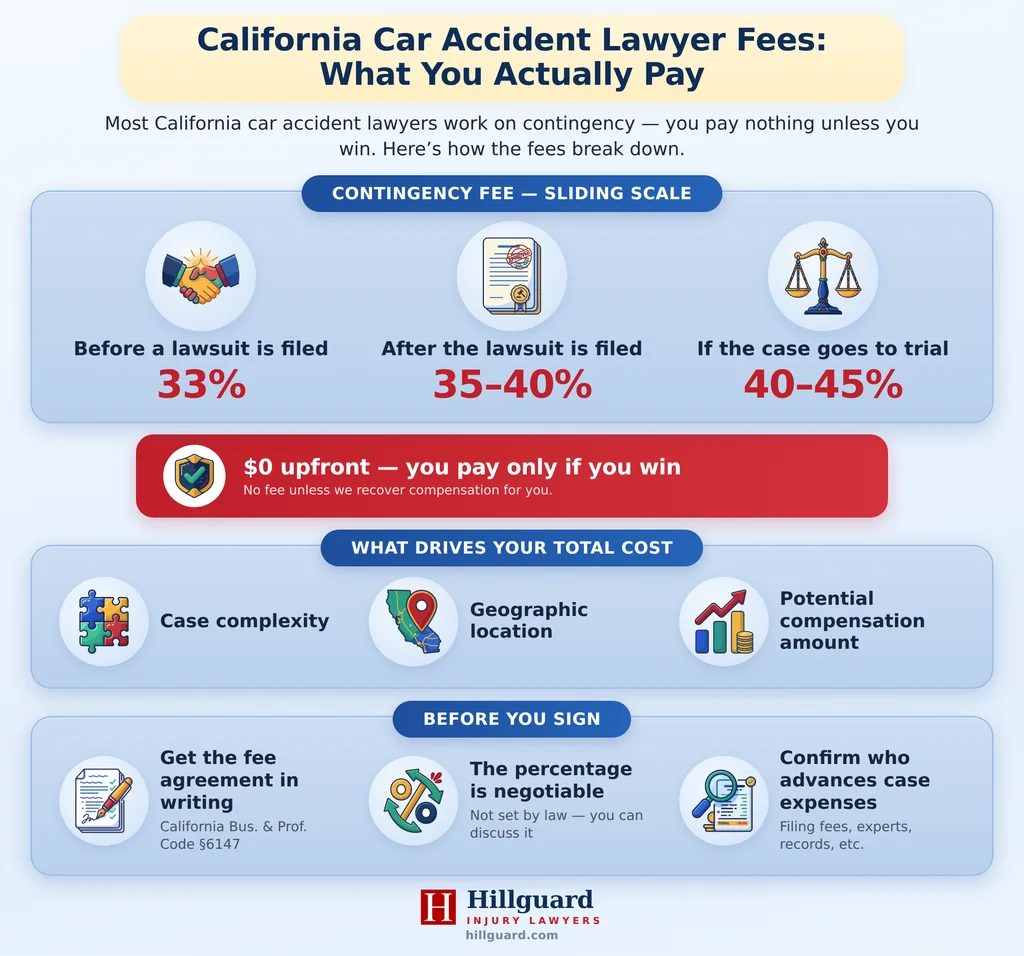
The table below shows the typical contingency fee percentage by case stage in California car accident practice. These ranges are conventions, not statutory requirements outside medical malpractice. The actual figure is whatever the written agreement says under B&P §6147.
| Case Stage | Typical Percentage | Governing Authority |
|---|---|---|
| Pre-suit settlement (before lawsuit filed) | 33% | No cap; §6147 written-agreement rule |
| Lawsuit filed (post-complaint, pre-trial) | 35–40% | No cap; contract-defined |
| Case proceeds to trial | 40–45% | No cap; contract-defined |
| Appeal | Often separate engagement | No cap; separate written agreement |
The Written Fee Agreement: What California Law Requires

California Business and Professions Code §6147 governs every contingency fee agreement in a car accident matter. The contract must be in writing, signed by the client and the attorney. The client must receive a duplicate original at signing. Verbal contingency arrangements are unenforceable in personal injury matters.
The statute requires specific disclosures on the face of the agreement:
- The contingency rate the lawyer will receive at each stage
- How disbursements and costs affect the contingency fee and the client's net recovery
- What the client owes for related matters not covered by the agreement
- A statement that the fee is negotiable between attorney and client and is not set by law
- In non-medical-malpractice cases, where no §6146 cap applies, and the fee is negotiable to the same extent
Under §6147, a contingency fee agreement in a car accident case must be in writing, signed by the client and the attorney, and must state that the fee is negotiable and not set by law. The California State Bar Rules of Professional Conduct carry parallel ethical duties on fee transparency. Therefore, contingency fee agreements missing any §6147 requirement are voidable by the client.
A written fee agreement is the primary legal document for the engagement. Consider the legal documents in the packet, including the fee agreement, HIPAA authorization, and lien acknowledgment, as a cohesive set.
Hourly Rates and Flat Fees: When Other Models Apply
Hourly billing exists in California legal services but rarely appears in car accident injury cases. Hourly fees for a personal injury attorney typically run $150 to $500 per hour depending on experience and location. Most personal injury lawyers will not take an auto accident case hourly because the bill quickly exceeds the recovery.
Flat fees apply to specific services such as a single demand letter, a one-time document review, or a consultation regarding settlement options. Flat fee services typically range from $500 to $5,000 for specific tasks in most California markets. However, it is quite rare to find full car accident representation offered at a flat fee.
In California, lawyers rarely use hourly billing or flat-fee arrangements for car accident injury cases. The contingency model removes the upfront cost barrier for injured claimants. The Bureau of Labor Statistics data on lawyer wages provides the broader hourly context, but contingency is the only model in active use at most firms.
Case Expenses vs. Attorney Fees: What's Actually Deducted

The attorney's fee and case expenses are two different line items on the settlement statement. Attorney fees come out as a percentage of the recovery. Case expenses refer to the out-of-pocket litigation costs, including court filing fees, police reports, expert witness fees, court reporter fees, deposition transcripts, medical records, and mediation fees, which are incurred as the case progresses.
Two billing models exist for case expenses in California:
- Advance-and-deduct: the law firm fronts costs and recovers them from the settlement, depending on the agreement.
- Client-pays-as-incurred: the client funds upfront costs as they come up. This is far less common in California car accident cases.
Hillguard advances case costs and deducts them from the recovery. Paying upfront costs is the problem that the contingency fee model exists to solve. The bodily injury claims process covers what generates each cost item as the file moves. Upfront legal fees are not a feature of the contingency arrangement at most California PI firms. According to the Insurance Information Institute, the US average third-party auto bodily-injury claim payout reached approximately $27,373 per injured party in 2024, up 8% YoY.
Common Case Expenses in California Car Accident Cases
| Expense Type | Typical Cost | Who Pays |
|---|---|---|
| Court filing fees (Superior Court complaint) | $370–$435 | Advanced by the firm, deducted from recovery |
| Police accident report | $20–$50 | Advanced by the firm |
| Medical records retrieval | $50–$500+ depending on provider | Advanced by the firm |
| Expert witness fees (reconstruction, medical) | $2,000–$15,000+ per expert | Advanced by the firm |
| Court reporter / deposition transcripts | $500–$2,500 per deposition | Advanced by the firm |
| Mediation fees | $1,500–$5,000 | Advanced by the firm or split |
| Trial exhibits, demonstratives, jury consultants | $2,000–$25,000+ | Advanced by the firm |
What Factors Drive the Final Cost of Your Case
Total legal costs vary depending on several factors, with case complexity being the most significant. Complex factors such as disputed liability, multiple defendants, commercial vehicle involvement, severe injuries, and contested causation increase the workload for attorneys. In California, the lawyer's fee is a fixed percentage that does not change; however, case expenses increase with the level of litigation effort required.
Geographic location matters. An accident lawyer in California working a file in Los Angeles, San Francisco, San Diego, or Sacramento sees higher court reporter rates, mediation rates, and expert fees than in a smaller-county venue. Attorney fees for each expense item align with local market rates.
The potential compensation amount also drives spending. Higher-value cases get more depositions, more expert work, and more investigation, which raises case expenses without raising the fee percentage.
What Happens If You Lose Your Car Accident Case?
No attorney fees are owed if the case does not produce a recovery; that is the core of the contingency promise. The lawyer's fee is contingent on a settlement or court award. No recovery, no fee.
Case expenses are a separate question. Hillguard Injury Lawyers advances costs and deducts them from the recovery, which is the typical model for car accident cases in California. If the case loses, the firm typically absorbs those advanced costs. The terms of the agreement are determined by the written contract. Be sure to review that section carefully before signing.
Under a California contingency fee agreement, the client owes no attorney's fee if the case does not result in a recovery. Depending on the written agreement, the client may still owe case expenses advanced by the firm. For a properly represented client, the financial risk is the time invested, not the lawyer's fee.
Is a Car Accident Lawyer Worth the Fee?
Paying 33% of a recovery you could not have gotten on your own is less than losing 33%. The question of whether a car accident lawyer is worth the fee really asks whether legal representation produces a larger net recovery than self-representation. According to the Insurance Research Council, auto injury claimants with attorney representation receive settlements 3.5x larger on average than solo claimants.
A skilled personal injury attorney maximizes case value by calculating the full claim. Medical bills, medical expenses, lost wages, future treatment, pain and suffering; every line item a self-represented claimant often misses. CACI 3903A covers past and future medical expenses as recoverable economic damages in California PI jury instructions. The right car accident lawyer reads adjuster behavior, pushes the insurance company past the lowball, and brings the file to fair compensation or trial.
Self-represented accident victims often accept the first offer. Maximum compensation tracks what the case is worth, not what the carrier first offers. Talk to a car crash attorney early.
Hidden Costs Most Clients Don't See Coming
A handful of costs surprise clients on the back end:
- Court reporter and deposition transcript fees, often $500 to $2,500 per deposition
- Expert witness fees at the higher end: $10,000+ for an accident reconstruction expert
- Mediation fees, usually split between parties
- Medical liens, health insurer subrogation, ER liens, Medicare or Medi-Cal liens eat into net recovery
- Court costs on appeal if the carrier appeals an adverse verdict
- Settlement-statement breakdown: every client should see line items for attorney fees, advanced costs, lien resolutions, and the net to the client.
Medical expenses and medical records retrieval can each run into the thousands on a complex file. Legal costs at trial multiply because of expert witnesses, jury consultants, and exhibit prep. An honest law firm walks you through every line item.
How to Read Your Fee Agreement Before You Sign

A contingency fee agreement is a contract, so read it before you sign. The initial consultation is the time to ask questions and the moment the attorney-client relationship is forming.
Pre-signing checklist:
- Confirm the percentages at each stage: pre-suit, post-filing, trial, appeal
- Confirm whether case expenses come off the recovery before or after the fee is calculated; this materially changes net to client
- Verify who is responsible for covering case expenses if the case is unsuccessful
- Confirm the agreement says the fee is "negotiable and not set by law," a §6147 disclosure
- Confirm any termination clause: what the lawyer is owed if you switch firms mid-case
- Confirm you walk out of the meeting with a signed duplicate original
Reading a fee agreement carefully sets the legal process up correctly from day one.
Common Mistakes to Avoid When Hiring a California Car Accident Lawyer
The mistakes below are fee-specific and cost real money once the settlement statement lands. Most of them get made in the first meeting under pressure. All issues can be resolved, but it is generally simpler to prevent them than to address them after they occur.
Don't Sign a Fee Agreement Without Reading It Line by Line
Many clients sign at the first meeting without reading the contingency rate, cost-advance rule, or termination clause. Those terms decide the back-end math. Take the agreement home, read it sober, and ask questions before signing.
Don't Hire a Lawyer Based on TV Ads or Billboard Volume Alone
Marketing spend is not the same as case results. Ask about California car accident experience, recent verdicts and settlements, and how the legal team handles fees in writing. A free initial consultation is the place to test that.
Don't Pay an Upfront Retainer for a Contingency-Eligible Case
Standard California car accident representation runs on contingency. An upfront retainer on a routine auto accident case is a red flag worth a second opinion.
Don't Forget to Ask Who Advances Case Expenses
The default answer varies from firm to firm. Some California firms advance every cost; others ask the client to fund expenses as they arise. Confirm the arrangement in writing before signing.
Don't Accept the Quoted Percentage Without Asking If It's Negotiable
B&P §6147 requires the agreement to state that the fee is negotiable. The "standard 40%" can sometimes be negotiated, especially on higher-value cases or matters the carrier will likely settle pre-suit.
Don't Assume All Firms Cover Expenses Up Front
Certain firms may absorb advanced costs on a losing case, while others may charge the client, so it's essential to clarify this in the written fee agreement.
Don't Pick a Lawyer on Percentage Alone
A 25% rate at a firm that will not try the case can produce a smaller net than a 40% rate at a firm the carrier knows will take the matter to trial. Net recovery is what matters.
Don't Ignore the §6147 Written-Agreement Requirement
Verbal contingency arrangements are unenforceable in California personal injury law. If a firm offers to "shake on it" without paperwork, walk.
Talk to a California Car Accident Lawyer Before You Sign Anything
California car accident lawyer fees follow a contingency model; accident victims get representation without writing a check up front. The right fee agreement protects the recovery, advances case expenses, and locks the percentage in writing. Calling early saves deadlines, preserves evidence, and keeps the carrier from valuing the claim before you do.
Hillguard Injury Lawyers represents California accident victims against major insurance carriers from Sherman Oaks and across the state. An experienced car accident lawyer can read the fee agreement before you sign, advance the costs, and put a real number on the claim. Contact us today for a free case review.
Frequently Asked Questions
Hillguard Injury Lawyers handles California car accident matters statewide. Our experience and expertise in car accident law enable us to provide answers to the questions below.
How Much Do Car Accident Lawyers Charge in California?
Most California car accident lawyers charge a contingency fee between 30% and 40% of the recovery. Typical breakdown: 33% pre-suit, 35–40% after the lawsuit is filed, and 40–45% at trial. No upfront fee is owed at intake.
Do I Pay Anything If I Lose My Car Accident Case?
No attorney fees are owed under a true contingency agreement if the case does not produce a recovery. Case expenses already advanced, filing fees, expert costs, and court reporter fees in car accident cases involving adults may still be owed depending on what the written agreement says. Ask the firm directly before signing.
Is There a Legal Cap on Car Accident Lawyer Fees in California?
No. California does not cap contingency fees in adult car accident cases. The sliding-scale cap in Business and Professions Code §6146 applies only to medical malpractice cases.
What's the Difference Between a Contingency Fee and a Retainer?
A contingency fee is a percentage of the recovery paid only if the case wins. A retainer is money paid upfront, either a flat amount or a deposit against hourly billing, that the lawyer earns out as work is done. Most California car accident cases run on contingency with no retainer.
Are Case Expenses Separate From the Lawyer's Fee?
Yes. The contingency percentage is the lawyer's fee. Case expenses, including filing fees, expert witnesses, deposition transcripts, and mediation costs, are separate line items deducted from the recovery in addition to the fee.
How Long Does It Take to Get Paid After Settling a Car Accident Case?
Once the settlement check arrives, the firm deposits it in a trust account, resolves outstanding medical liens, deducts the fee and advanced costs, and pays the client the net. The total timeline usually runs 30 to 90 days from signed release to client check. Medicare or Medi-Cal lien resolution can push that out.
Can I Negotiate a Lower Contingency Percentage?
Yes. California Business and Professions Code §6147 requires the agreement to state that the fee is negotiable and not set by law. Higher-value or simpler cases sometimes settle at a lower percentage.
What Should Be in a California Car Accident Fee Agreement?
Under §6147, the agreement must be in writing, signed by both the client and the attorney, and must state the contingency rate, how case costs affect the recovery, what the client owes on related matters, and that the fee is negotiable. The client must receive a duplicate original at signing.