

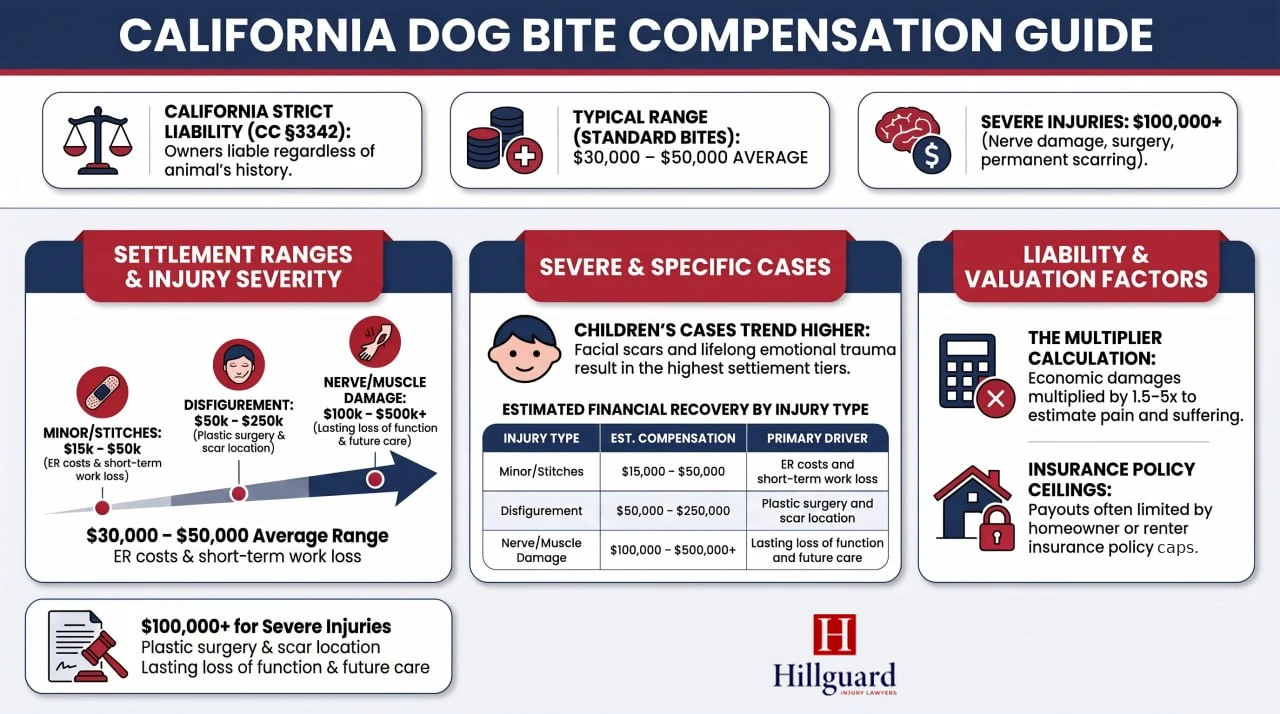
In California, the average compensation for a dog bite typically ranges from about $30,000 to $50,000 for cases that settle without trial, with severe injuries pushing well past $100,000 once medical care, scarring, and lost income are factored in. The honest answer is that no single "average" captures every case; the range is wide because the injury is what determines the value.
Hillguard Injury Lawyers has years of experience representing California dog bite victims and pursuing fair compensation through homeowner's and renter's insurance carriers. Our dog bite injury attorney team builds the medical, financial, and liability evidence that supports the upper end of the range available under California's strict-liability law. Contact us for a free consultation about your case.
This article walks through what California dog bite settlements typically pay, how compensation is calculated, the factors that drive value up or down, who actually pays, and how long you have to file a claim under California law.
What Is the Average Dog Bite Settlement in California?
There is no single number that represents the average payout for a dog bite in California, because the range is wide and the injury is what sets the value. Most people who are bitten and settle out of court land somewhere in the $30,000 to $50,000 range, but a minor puncture that heals in a week and a child's facial reconstruction case are not the same matter, and the dollar figures reflect that.
The arithmetic mean across all California settlements is a misleading point on its own; the median tells a clearer story for a normal case, and the upper tail of the range is what matters once a serious injury is involved.
What California does have, that many states do not, is a strict-liability rule that makes recovery more straightforward than in jurisdictions where the victim has to prove the owner knew the dog was dangerous. That difference shows up in average settlement values because more cases get paid and more cases get paid faster.
How Dog Bite Compensation Works Under California Law
California Civil Code §3342 makes a dog owner liable for the injuries their dog causes by biting someone in a public place or lawfully on private property, regardless of whether the dog had any prior history of aggression. There is no "one free bite" in California. The owner cannot defend a claim by saying the dog had always been friendly, because the statute does not ask about the dog's history at all.
The strict-liability rule has limits. It covers bites, not every injury caused by a dog (a person knocked down by an excited dog is a different kind of negligence claim). Furthermore, the rule falls away if the bitten person was trespassing, was provoking the dog, or was bitten by a police or military dog doing its job. Those exceptions are where insurance carriers spend most of their energy, and where the owner's actual conduct (whether they failed to control the dog, ignored leash laws, or kept a dog with known aggression issues) still matters for valuing the case.
Factors That Affect the Average Compensation Amount
Two bites are never the same case. The factors below are what move a California dog bite settlement up or down most reliably.
- Severity of the injury. The single biggest driver. A wound that heals clean settles low; a wound that needs surgery, leaves a permanent scar, or causes lasting nerve damage settles high. Severe injuries typically result in higher compensation amounts in California.
- Location of the bite on the body. Faces and hands carry more value because the scarring is visible and the function matters.
- Age of the victim. A scar on a young child is treated as a lifelong injury, which is reflected in the settlement number.
- Medical bills and lost income. These are the documented basis of every claim; everything else is built on top of them.
- Insurance available. Most California dog bite claims are paid out of the owner's homeowner's or renter's liability policy, with typical limits of $100,000 to $300,000. That ceiling is often the real cap on the case.
- Strength of liability. A clear-liability bite with witnesses and no provocation settles higher than one that the insurer can challenge by arguing provocation, trespass, or shared fault.
- Location of the incident. Different jurisdictions in California can apply slightly different procedural rules and have different jury patterns, which can influence what a case is worth at trial or in pre-trial settlement.
Average Compensation by Injury Type
The table below groups California dog bite cases by the type of injury and the typical compensation range each falls into. The ranges are illustrative, not promises; two cases with the same injury type can settle far apart depending on the insurance available and the strength of the documentation. The ranges below are grouped by injury type; the table summarizes the typical dollar figures.
| Injury Type | Illustrative Compensation Range | Key Drivers of Value |
|---|---|---|
| Minor single bite; heals without surgery | A few thousand to about $15,000 | Low medical cost, full recovery, no scarring |
| Bite needing stitches or wound repair | $15,000 to $50,000 | ER and follow-up care, short work loss, minor scar |
| Significant scarring or disfigurement | $50,000 to $250,000 | Plastic surgery, permanent scar, location on the body |
| Nerve, tendon, or muscle damage | $100,000 to several hundred thousand | Lasting loss of function, future medical treatment |
| Child with facial injury | Often the highest range | Permanent visible scar, lifelong emotional impact, long horizon |
| Fatal attack (wrongful death) | Policy-limit dependent, often the maximum available | Loss of a family member; capped by available insurance |
The ceiling on most California dog bite cases is not the injury; it is the insurance. A catastrophic injury can be worth more than the policy holds, and collecting past the limit means finding an umbrella policy or reaching personal assets.
Types of Compensation You Can Recover
California law splits what a dog bite victim can recover into two categories. The first covers losses with a receipt or pay stub behind them. The second covers harm that is real but has no invoice. The table breaks down what fits in each.
| Economic Damages | Non-Economic Damages |
|---|---|
| Emergency room and hospital bills | Pain and discomfort |
| Plastic or reconstructive surgery | Emotional distress and PTSD |
| Future medical care | Anxiety about dogs |
| Lost wages and lost earning capacity | Visible scarring and disfigurement |
| Medication and physical therapy | Loss of enjoyment of daily life |
Children's cases tend to lean heavily on the non-economic column. A young child often has modest medical bills but a substantial claim because the facial scar and the lasting fear of dogs follow them for decades.
How Dog Bite Settlement Amounts Are Calculated
There is no formula a California court hands out, but the calculation tends to follow the same path in every serious case. Start with the economic damages, which are calculated dollar-for-dollar from verifiable medical bills, invoices, and employment records showing lost income. Add the projected costs of future medical care if the injury needs more surgery or therapy, plus any other anticipated expense the documentation can support. Then estimate non-economic damages, which insurance carriers and plaintiffs' lawyers commonly calculate using a mathematical shortcut known as the multiplier method: take total economic damages and multiply by a factor between 1.5 and 5, depending on the severity of the injury and the permanence of the harm.
The multiplier is a rough sense of how much the pain, scarring, and disruption to everyday life are worth in the context of the case. Finally, measure the total against the policy ceiling, because a claim worth more than the available money on the policy usually settles at or near the policy limit unless other assets are reachable.

Punitive damages are rare but possible. Under California Civil Code §3294, a plaintiff can recover punitives where the conduct involved oppression, fraud, or malice, proven by clear and convincing evidence. In dog bite cases, that typically requires a showing of gross negligence (a known dangerous dog kept loose despite prior incidents, for example), not ordinary negligence.
Who Pays Dog Bite Compensation in California?
The owner is legally on the hook, but the payment usually comes from insurance. The most common sources, in order:
- Homeowner's insurance. The primary source in most California dog bite cases. Standard policies include liability coverage of $100,000 to $300,000.
- Renter's insurance. Renter's liability coverage works the same way and applies if the owner rents rather than owns.
- Umbrella policy. Sits on top of the underlying homeowner's or renter's policy and adds another $1 million or more in coverage. This is critical in serious-injury cases.
- Personal assets. When the owner is uninsured, or the injury exceeds available coverage, the recovery comes from the owner personally, which is harder to collect and often limits what a case actually pays out.
Insurance Information Institute data shows California has consistently led the country in both the number of dog bite claims and the total dollar amount paid out. That reflects both the state's population and the strict-liability rule that makes claims easier to bring than in many other jurisdictions.
How Long Do You Have to File a Dog Bite Claim in California?
The statute of limitations is two years from the date of the bite, under California Code of Civil Procedure §335.1. Miss that deadline and the court can throw the case out no matter how clear the fault.
Two narrower deadlines apply in specific circumstances. Claims against a government entity (a county-owned animal, an incident on public property) require a formal claim within six months under California Government Code §911.2 before a lawsuit can even be filed. Cases involving minors have tolling rules that can extend the deadline, but acting quickly still protects the evidence and the claim.
How a California Dog Bite Lawyer Affects the Compensation You Recover
The work that raises a dog bite settlement is mostly documentation. A lawyer pulls together the medical records and the photos that show the scar at its worst, finds every insurance policy that might apply (homeowner's, renter's, umbrella), and ties the injury to the bite so the carrier cannot wave it off. When the insurer argues the victim provoked the dog or was trespassing, the answer is evidence: the witnesses, the location, the dog's behavior before and after the incident, animal control reports, and any prior complaints about the dog.

Most California dog bite claims settle without a lawsuit. The ones that do not are usually the cases where the carrier disputes liability or lowballs a serious injury, and those are the cases where having a lawyer ready to file changes what the carrier is willing to pay.
Ready to Talk to a California Dog Bite Lawyer?
A dog bite case is won on documentation, liability evidence, and finding every dollar of insurance the owner carries. Working with an experienced dog bite lawyer is the most reliable way to make sure your medical records, photographs, witness accounts, and economic damages all support the highest fair recovery the policy will pay. Hillguard Injury Lawyers handles California dog bite cases on a contingency basis: no fee unless we recover for you.
Our team includes an experienced dog bite injury attorney who has represented victims across Los Angeles and the surrounding counties. We investigate, negotiate, and prepare every case as if it could go to trial, because that is what moves the carrier's number. Contact us today for a free, confidential review of your case.
Frequently Asked Questions
At Hillguard Injury Lawyers, we have years of experience and frequently encounter inquiries about dog bite injuries and the available compensation. Here are some of the most common questions we are asked and their answers.
Does Homeowner's Insurance Cover All Dog Bites?
Usually, yes. Most homeowner's and renter's policies cover dog bite liability, and that policy is where the majority of settlements are paid from. Some carriers exclude certain breeds; some apply lower sub-limits for animal liability. Check the policy early to know what's available.
How Much Can a Child Dog Bite Victim Recover?
Child cases often value higher than adult cases with similar physical injuries because a permanent scar and lasting fear are treated as lifelong harm. A settlement for a minor in California also has to be approved by the court before it can be paid, which adds a procedural step but protects the child's recovery.
What if the Dog Had Never Bitten Anyone Before?
It does not matter in California. Civil Code §3342 makes the owner liable regardless of the dog's prior history. A clean record is not a defense, and there is no need to describe the dog as having an "average" or representative temperament. The word "average" is not in the statute.
How Long Does a Dog Bite Settlement Take?
Straightforward cases can settle in a few months. Cases involving serious injuries, disputed liability, or a child often take a year or more, and compensation can rise as the medical picture clarifies and the full cost of the injury comes into view. Cases that go to trial take longer.
Do I Need a Lawyer for a Minor Dog Bite?
If you were not seriously hurt and the damage is small, you may not. If you saw a doctor, missed work, or the insurer is disputing the injury, a free consultation with a dog bite lawyer is worth the call before signing anything.
Legal Disclaimer
This article is general information about California dog bite law and is not legal advice. The compensation ranges and statistics discussed are illustrative or drawn from published industry data, not predictions about any specific case; past results do not guarantee future outcomes. Reading this page does not create an attorney-client relationship. For advice about your situation, speak with a licensed California attorney.